A director we spoke to recently had run her business for eleven years without ever proving who she was to Companies House. Then a letter turned up, asking for a passport scan, a facial check, and a code she’d never heard of. That’s the experience a lot of UK directors are having right now, and it’s why this verify your identity for Companies House guide exists.
It’s more than uploading a photo of your driving licence. You need to know whether you’re even required to verify, pick the right route, get a personal code, and then actually use it correctly afterwards. All of that’s covered here, along with the deadlines and what happens if you miss the window.
What Is Companies House Identity Verification?
It’s a legal check confirming that a director or PSC is a real person, matching the name and details they’ve claimed. Nothing more mysterious than that, though the process has a few moving parts.
Why Has Companies House Introduced Identity Verification?
For years, pretty much anyone could register as a company director using almost any name. There was barely any check on whether that person was even real, and fraudsters exploited it constantly. The reforms close that gap. They make the register something people can actually trust, rather than a list of unverified names. A similar push toward verified credentials shows up elsewhere too, like the Competence Assessment Programme for professionals.
Is Companies House Identity Verification Mandatory?
Yes. From 18 November 2025, it became a legal requirement for directors, PSCs and LLP members, phased in over a 12-month transition. That fits a wider pattern of UK regulators tightening scrutiny, similar to HMRC’s growing use of AI to check R&D tax claims.
What Does the Identity Check Actually Confirm?
Just that you are who you say you are. That’s the whole point. It says nothing about your suitability as a director, only your identity. Registering a company and verifying your identity are two separate steps, even though people often assume they’re the same thing.
Who Needs to Complete Companies House Identity Checks?
Do Company Directors Need to Verify?
Every individual director does, whether they’ve run the company for two decades or were appointed last week. New directors verify before appointment. Existing directors get folded into the transition period, tied to their company’s next confirmation statement. Running several companies doesn’t get you a free pass, either the requirement follows the person, not the company.
Do People With Significant Control (PSCs) Need to Verify?
Yes, and separately from any director obligation. A PSC broadly holds more than 25% of shares or voting rights, or otherwise exercises significant control. Being a shareholder alone doesn’t automatically make someone a PSC.
What If You Are Both a Director and a PSC?
Then two separate obligations apply. As a director, you confirm your identity check alongside the confirmation statement. As a PSC, your personal code needs submitting within 14 days of that same date.
Do You Need to Verify for Every Company?
No. Verification is a one-off process tied to you as an individual. Once it’s done, your personal code links to every directorship or PSC role you hold.
When Do You Need to Verify Your Identity?
What Changed From 18 November 2025?
That’s the official start date for mandatory verification. Before it, verification was voluntary and over a million people did it anyway.
How Does the Company’s House Verification Deadline Work?
There isn’t one single company’s house verification deadline for everyone. Your date depends on whether you’re new or existing, a director or PSC, and when your confirmation statement falls.
When Do Existing Directors Need to Complete Verification?
Before the company’s next confirmation statement filed after 18 November 2025.
When Do New Directors Need to Verify?
Before the appointment is notified to Companies House. For brand-new companies, first directors verify before incorporation.
When Do PSCs Need to Verify?
If you’re a PSC and a director of the same company, your code needs to be submitted within 14 days of the confirmation statement date. PSC but not a director? That’s different: the clock starts from the first 14 days of your birth month.
What Are the Companies House Verification Requirements?
What Proof of Identity Do You Need?
This depends on the route. GOV.UK One Login generally works with a UK passport, a biometric residence permit, or a UK driving licence, plus a facial verification step. An ACSP accepts a wider set of documents.
Do You Need a Photo ID?
Almost always. Companies house photo ID sits at the centre of the process, matched against your facial verification.
What Personal Details Need to Match?
Your name, date of birth, and document details need to line up with what’s on record. A maiden name still on file? That alone can cause a hold-up.
Can You Use a Foreign Identity Document?
Sometimes, but not automatically. Overseas individuals often need an ACSP instead.
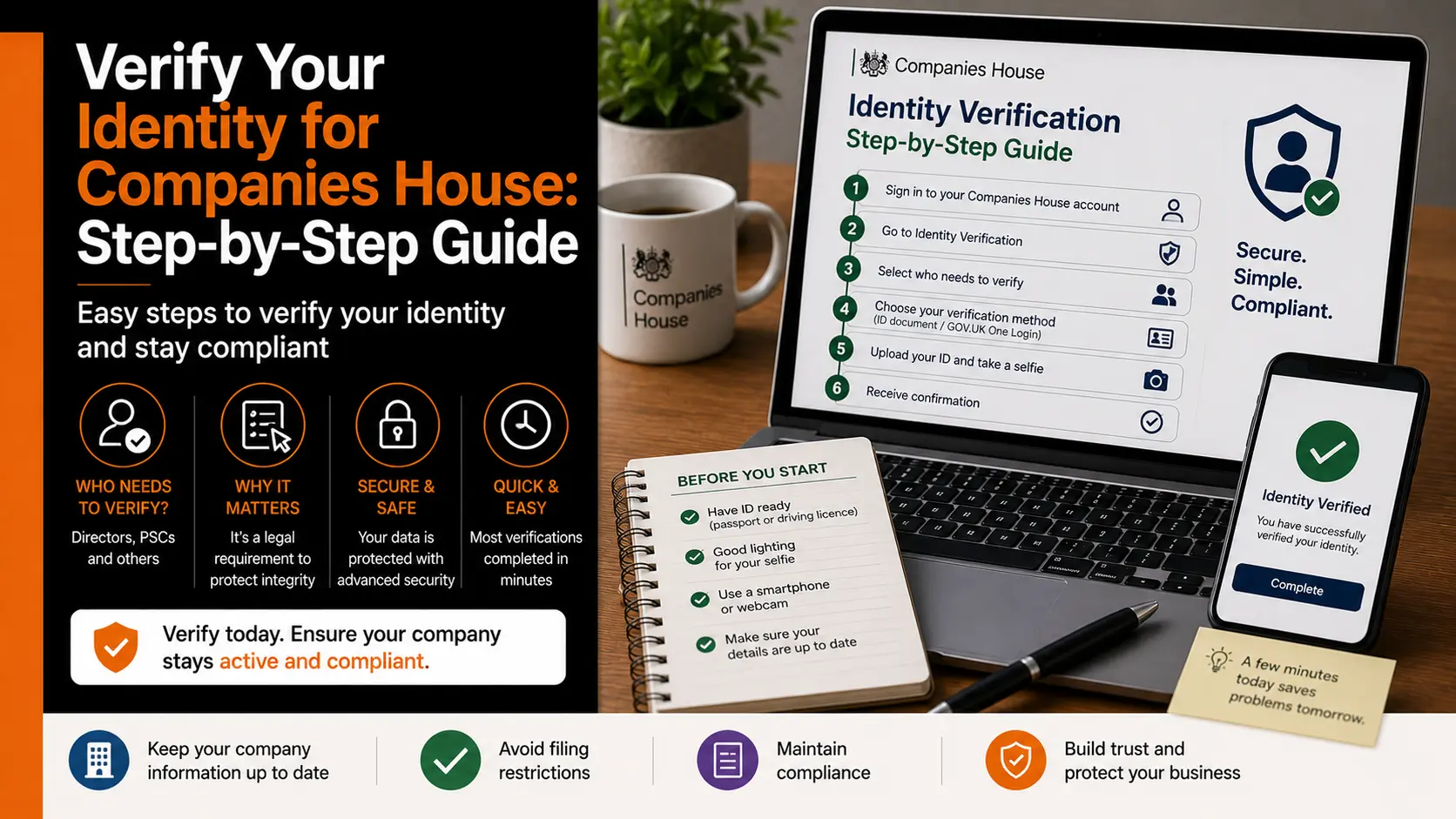
How to Verify Your Identity for Companies House? Step-by-Step
Step 1 Establish Whether You Need to Verify
Work out which category you fall into: director, PSC, both, or someone about to be appointed.
Step 2 Prepare Your Identification
Get your photo ID ready, along with any supporting details Companies House already holds on you.
Step 3 Choose Your Verification Route
GOV.UK One Login is free and works well for straightforward UK-based cases. An ACSP suits more complicated situations.
Step 4 Complete the Identity Check
Through GOV.UK One Login, that means uploading your ID and doing a facial scan. Through an ACSP, the provider handles the checks and confirms your identity directly.
Step 5 Receive Your Companies House Personal Code
Once verified, you’re issued a unique personal code. Keep it secure Companies House won’t simply hand it back without going through a proper recovery process.
Step 6 Use the Code Where Companies House Requires It
Finishing the check isn’t the final step. Submit the code at the right moment, whether that’s a confirmation statement, a new appointment, or an incorporation.
Step 7 Check That Your Company Record Is Up to Date
Confirm the requirement actually shows as met, rather than just assuming it went through.

GOV.UK One Login vs Authorised Corporate Service Provider
| Feature | GOV.UK One Login | ACSP |
| Verification route | Direct with Companies House | Through a professional provider |
| Professional assistance | None | Included |
| Suitable for straightforward cases | Yes | Yes |
| Useful for complex cases | Limited | Yes |
| Potential cost | Free | Provider fees apply |
| Overseas usefulness | Limited | Often more flexible |
When Is GOV.UK One Login the Simpler Option?
When you’re UK-based, hold standard UK ID, and don’t need any help getting through the process.
When Might an ACSP Be More Useful?
When your documents don’t fit the online system, you’re overseas, or you’d honestly rather have an accountant handle it. Companies house verify director duties through an ACSP feel a lot less fiddly for anyone juggling several company roles at once.
What Does an ACSP Actually Do?
It’s a regulated firm authorised to carry out identity checks and confirm the result to Companies House. It handles the mechanics. It doesn’t replace the requirement itself, though.
What Is the Company’s House Personal Code?
What Is a Personal Code?
A unique reference is issued once your identity is verified, confirming that to Companies House whenever it’s needed.
Why Is the Personal Code Important?
It links you as a verified individual to every company role you hold. Without it, Companies House has no confirmed record of your company’s house identity confirmation.
Do You Use the Same Personal Code for Multiple Companies?
Yes. One code, tied to you personally, covers every role across every company.
What If You Lose Your Personal Code?
Go through the official recovery process via your GOV.UK One Login account, or through your ACSP.
Personal Code vs Companies House Authentication Code
The authentication code is older and relates to filing documents. The personal code is newer, tied to identity, and belongs to you rather than a specific filing.
Companies House Identity Verification vs Other Checks
Identity Verification vs AML Checks
Anti-money laundering checks, run by banks and regulated professionals, look at risk and source of funds. Identity verification just confirms who you are, nothing more.
Identity Verification vs KYC
Know Your Customer checks are typically run by banks. Companies House identity verification is a separate statutory requirement tied to company registration.
Identity Verification vs Companies House Authentication
Authentication relates to filing paperwork online. Companies house authentication service access and identity verification sit alongside each other, not on top of one another.
Personal Code vs Authentication Code
One confirms your identity. The other lets you file documents. Two different jobs.
Identity Verification vs Company Registration
Registering a company creates the legal entity. Verifying confirms who’s actually behind it. From 18 November 2025, new companies generally can’t register until their directors have gone through verification.
What If Companies House Cannot Verify Your Identity?
What If Your Photo ID Will Not Scan?
Try better lighting and a flatter surface first. Still failing? An ACSP route may work better.
What If the Facial Check Fails?
Usually it’s poor lighting, or a mismatch with an older photo. Retrying under different conditions often fixes it.
What If Your Personal Details Do Not Match?
Check what Companies House holds against your ID. An old address is a common culprit here.
What If Your Identity Check Is Rejected?
Try again, or switch routes if the online system keeps failing on you.
What If You Completed Verification but Your Record Has Not Updated?
Give it a bit of time, then check your company record. Still nothing after a reasonable wait? Contact Companies House or your ACSP.
When Should You Use an Alternative Verification Route?
Repeated failures with GOV.UK One Login, or documents that just don’t fit its accepted list, are good reasons to switch to an ACSP.
How Long Does Companies House Identity Verification Take?
How Long Does Online Verification Take?
Often just minutes, assuming your ID scans properly and the facial check works first time.
How Long Does Verification Through an ACSP Take?
Varies by provider, depending on their process and how quickly you supply documents.
How Long Does It Take to Receive the Personal Code?
Usually straight after verification, though companies’ house verification time can stretch longer if additional checks are needed.
What Can Cause Delays?
Mismatched personal details, poor-quality scans, and incomplete information all fairly avoidable, honestly.
What If You Are an Overseas Director or PSC?
Can Overseas Directors Complete Identity Verification?
Yes, though the process looks a bit different depending on where you’re based and what documents you hold.
Can You Use a Foreign Passport or ID?
Often, particularly through an ACSP. Not every foreign document is accepted through the standard GOV.UK route.
What If the Digital Verification Route Does Not Work?
An ACSP is usually the practical fallback for overseas individuals who can’t get through GOV.UK One Login directly.
Can an ACSP Help an Overseas Individual?
Yes and for many, this ends up being the more straightforward option from the outset anyway.
What Happens If You Do Not Complete Identity Verification?
Can You Continue Acting as a Director?
Not indefinitely. Acting as a director without completing verification by your deadline is treated as an offence.
Can You File a Confirmation Statement?
No, not without the required personal code which effectively blocks routine filings altogether.
Can You Be Appointed as a New Director?
No. New appointments require verification first, full stop.
What Could Happen If You Ignore the Requirement?
The company could become unable to file. The director could face restrictions on continuing in the role. In more serious cases, the company risks eventually being struck off.
Common Companies House Identity Verification Mistakes
- Assuming every director has the same deadline. It depends on individual filing dates.
- Thinking the ID check is the whole process. Using the code correctly matters just as much.
- Forgetting the personal code. Save it. Don’t complete the check and just move on without it.
- Ignoring PSC requirements. Director verification doesn’t cover a PSC role too.
Companies House Identity Verification Checklist
- Identify whether you need to verify, and check your deadline
- Prepare acceptable ID and confirm your details match Companies House records
- Choose your verification route and complete the identity check
- Receive your personal code and store it securely
- Provide the code wherever required, then confirm your company record is updated
Conclusion
Identity verification is now a genuine part of running a UK company, not an optional extra. Directors and PSCs need to work out their own role, deadline and verification route rather than assuming the same rules apply to everyone.
The identity check, the personal code, and using that code correctly are three separate steps. Skip one, and the job’s only half done. Treat this, verify your identity for the Companies House guide as a starting point, and check the latest guidance on GOV.UK before relying on anything you’ve read here. SeeNews keeps tracking these changes as they land.