Introduction
A tribunal case landed in 2026. It should worry anyone using AI for tax claims. An adviser sent in AI-written text for an R&D claim. He didn’t check it first. The tribunal called this “professional incompetence”.the First-tier Tribunal’s decision in Gary Elden v HMRC [2026] offers a stark reminder: submitting AI-generated content that has not been properly verified was characterised as professional incompetence.
That’s the real state of HMRC R&D tax claim transparency right now. It says a lot about hmrc r&d tax claim ai use too. AI tools help draft claims faster. They help sort evidence too. But HMRC wants full human proof behind every word. Strict rules exist now. The Additional Information Form is a must. Checks keep rising each year.
This guide covers who can claim. It covers AI’s real role too. It shows what proof HMRC wants. It covers common slip-ups, plus how to get ready for a check.
What Is HMRC R&D Tax Claim Transparency?
Real hmrc r&d claim transparency means HMRC can see how your claim got made. This holds true whether a person wrote it, or AI helped. Each fact needs a clear source. Each number needs to trace back to real work.
Why has scrutiny grown so much? About 17% of claims now face a check. Of those checked, 77% need some change. That’s a tough spot for weak proof.
AI is shifting this on both sides. HMRC’s own staff use Microsoft Copilot now. Over 28,000 licences went out by March 2026 more than 28,000 Microsoft Copilot licences had been issued to colleagues by March 2026. A human still makes each final call, though. AI doesn’t say yes or no to your claim while they are using AI internally, human caseworkers still make the final decisions.
One more legal point matters here. A tribunal forced HMRC to show its AI use, after HMRC first said noFirst-tier Tribunal forced HMRC to disclose AI use in R&D tax claim assessments, overturning both HMRC and ICO refusals. The judge said secrecy “harms trust.” Openness now runs both ways.
Understanding R&D Tax Relief Before Using AI
R&D tax relief rewards real technical work. Knowing your r&d tax relief eligibility first, before you touch AI at all, matters more than most firms think. This means work that solves real science or tech doubt. It’s not just a prize for being clever.
Most limited firms can claim, if the work fits. Software, engineering, and factory work often fit well. Small tweaks or basic setup usually don’t count, though.
The real test is technical doubt. Could a skilled pro in your field have solved this with ease? If yes, it likely won’t qualify. If truly not, your claim stands stronger.
Can AI Be Used to Prepare an R&D Tax Claim?
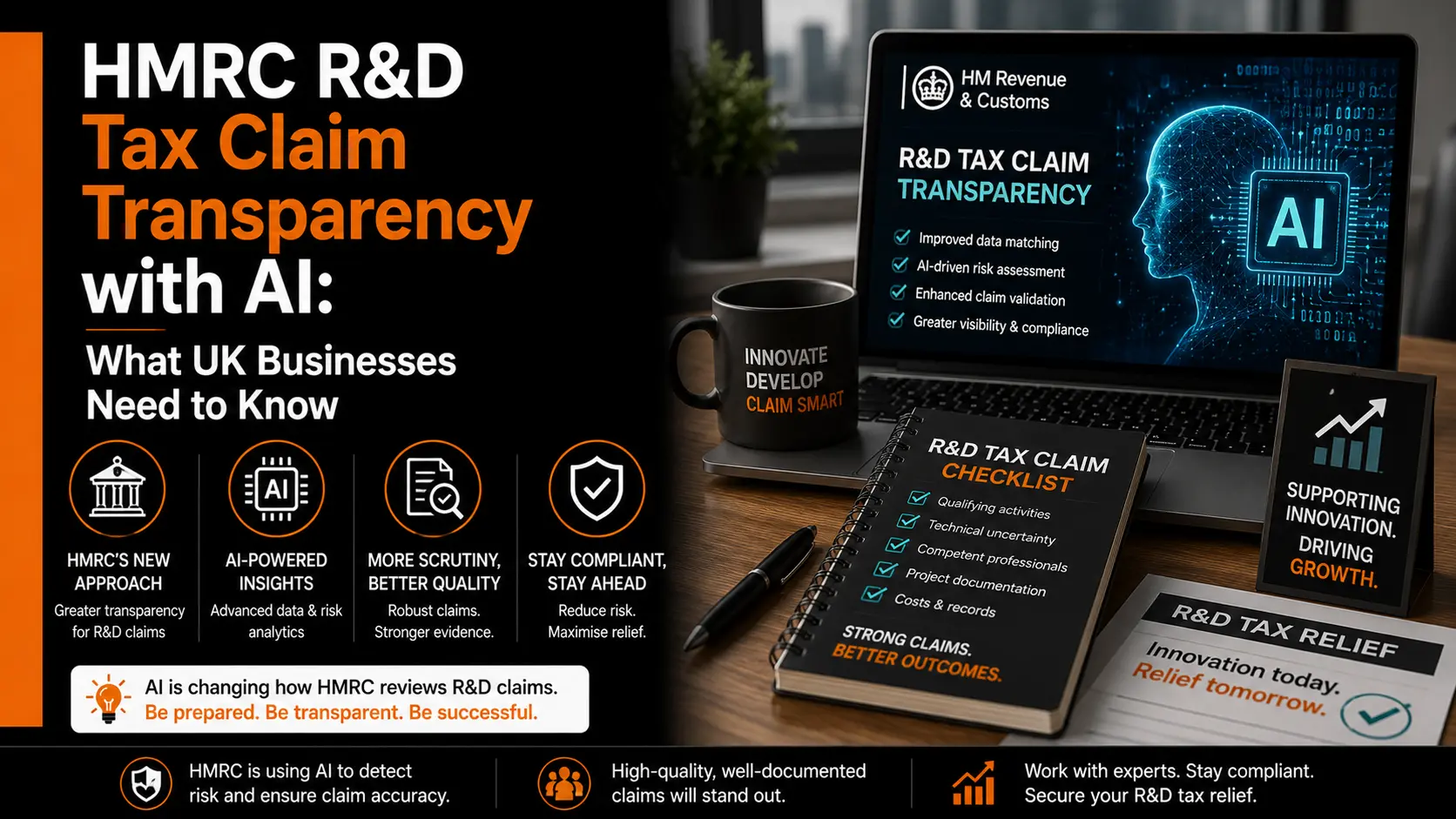
Yes, but only for parts of it. HMRC R&D Tax Claim Transparency with AI means using AI as a support tool rather than a replacement for expert judgment. AI works well as a drafting aide. It can sort messy notes into a clean structure and summarise lengthy technical documents to save time.
What AI should never do is decide your eligibility or write your core technical narrative without expert review. HMRC’s own guidance is clear on this. A skilled professional’s opinion cannot come from a prompt. The opinion of a competent professional must explain the current state of knowledge in the field and why the project represents a genuine advance relative to that baseline. This is a factual assessment based on the expertise of a specific individual at a specific point in time. It cannot be generated by AI alone.
Human oversight remains essential throughout the process. A qualified technical expert should review every AI-generated section line by line to verify its accuracy, completeness, and compliance. Following the principles of HMRC R&D Tax Claim Transparency with AI helps businesses use AI responsibly while ensuring that every claim is supported by genuine technical evidence and professional judgment.
What Are HMRC’s Expectations Around AI and Transparency?
Good ai compliance for r&d claims starts with one plain rule: truth beats speed here. A fast claim built on shaky AI text is worse than a slow, solid one. HMRC holds you fully to blame no matter who or what drafted the words.businesses using AI to prepare claims remain responsible for every technical statement, calculation and submission.
Each claim needs real proof behind it, not just slick text. AI text must get checked by a real expert first. Skip that step, and your risk climbs fast.
What Evidence Does HMRC Expect?
A strong r&d claim supporting evidence guards your claim far more than neat prose does. Good AI evidence for r&d use means AI can sort these files. It can’t make them from thin air, though. Here’s what counts most:
| Evidence | Why It Matters | Recommended |
| Technical project documentation | Shows the real work done | Essential |
| Development timelines | Proves work happened when claimed | Essential |
| Technical uncertainty records | Core proof of eligibility | Essential |
| Test results and prototypes | Shows genuine experimentation | Strongly recommended |
| GitHub or version control logs | Contemporaneous proof | Strongly recommended |
| Meeting notes and decision logs | Shows real-time reasoning | Recommended |
| Employee time records | Supports cost claims | Essential |
Notes made at the time beat notes made later. A note from during the work carries more weight than a summary written months on.
What Are the R&D Tax Claim Requirements?
Each claim needs the Additional Information Form now. This sits at the top of the r&d tax claim requirements firms miss most. It’s been a must since August 2023, for SME relief and RDEC claims alike from 8 August 2023, all companies making R&D tax relief claims must complete an additional information form (AIF) to accompany the claim. Skip it, and HMRC won’t count the claim as valid. Meeting hmrc r&d disclosure requirements on this form matters as much as the tech story itself.
Get your numbers right on this form too. Wrong state aid figures aren’t a “close enough” thing.if your state aid numbers are off, you risk breaching regulations. Small slips, like one wrong UTR digit, can now get fixed through a written note, not an auto-reject error in UTR numbers or dates that previously triggered automatic rejections can now be corrected through representations. That’s a fair shift from the old, stricter rule.
What Is the R&D Tax Claim Process, Step by Step?
Here’s the full r&d tax claim process. This r&d tax claim timeline shows what to expect at each stage:
- Confirm project eligibility against the technical uncertainty test
- Gather technical evidence as work progresses, not afterward
- Record financial costs and employee time accurately
- Prepare technical narratives with genuine expert input
- Review any AI-assisted content carefully, line by line
- Complete the Additional Information Form correctly
- Submit the claim through your Agent Services Account or directly
- Prepare for possible follow-up questions from HMRC
One more thing for firms using an adviser. From 18 May 2026, tax advisers must sign up with HMRC before they submit for a client mandatory registration begins 18 May 2026. Who it affects: any business providing tax services or interacting with HMRC on behalf of clients.
How Does AI Compliance Risk Show Up in R&D Claims?
Made-up tech details pose the biggest risk. AI tools can invent facts that sound real. This is called a hallucination, and it happens a lot. Wrong tax tips from a general AI chat tool are another real risk.
Flat, copy-paste language stands out too. HMRC’s own systems can flag claims that read like every other AI draft, avoid templated language that AI could flag across multiple submissions, and provide project-specific technical narratives with sector context. Leaning too hard on AI, with no real check, stays the top risk firms face today.
What Happens After You Submit a Claim?
Under hmrc r&d compliance uk rules, HMRC checks each claim first, against its own files. About 17% then move to a full check, so real hmrc r&d enquiry risk sits higher than most firms think. From there, HMRC may ask for more files, or ask hard tech questions about your work.
Four outcomes can follow: full pass, a part change, a further check, or a flat no. Since 77% of checked claims need some change, don’t assume a clean pass just from tidy paperwork.

Why Do Claims Get Questioned or Rejected?
Weak proof tops the list, every time. Poor tech stories, most of all vague ones, come a close second. Weak cost proof, mixed-up files, and AI slips nobody caught all follow close behind.
A lack of real, skilled input sits at the root of most of these. AI can help sort a claim. It can’t swap in for real tech judgement.
AI-Assisted Claims vs Professionally Prepared Claims
| Option | Cost | Accuracy | Compliance Risk | Best For |
| AI-only drafting | Low | Variable | High | Not recommended alone |
| In-house preparation | Medium | Depends on expertise | Medium | Businesses with strong technical staff |
| Specialist R&D adviser | Higher | Strong | Low | Complex or high-value claims |
| Hybrid AI + human review | Medium | Strong | Low | Most businesses |
The mix path tends to win. AI speeds up the draft and sort work. A real expert still checks each tech claim before it goes in. This forms the base of any solid r&d tax relief checklist. Getting ready for hmrc ai compliance checks now means this habit goes into every claim, not just the risky ones.
How Do You Avoid R&D Claim Penalties?
Real r&d claim audit preparation starts well before HMRC asks a thing. Keep an honest trail from day one. Log tech choices as they happen, failed tries too. Version logs help a lot here, since they stamp real work as it happens.
Never treat AI text as fact by default. Check each number, each tech claim, and each date against your real files. This one habit dodges most risk on its own. A sound r&d tax advisor uk firms can trust adds real worth here, most of all on big or tricky claims.
Common Mistakes to Avoid
Using AI with no check tops the list. Leaning on flat, copy-paste AI text comes next. Sending a claim with too little proof is another frequent slip.
Failing to log tech doubt well causes real harm too. So does skipping HMRC’s file rules, or waiting till year-end to gather proof you should have caught months back. Treating AI text as fact by default rounds off the list of habits worth dropping now.
Final Thoughts
Openness, real proof, and smart AI all matter more each year in R&D claims. Mix AI’s speed with real human skill, rather than leaning on it alone.
Solid files, careful checks on AI text, and close eyes on current HMRC rules all cut your risk. Seenews tracks these shifts as HMRC calls them out, so stay in the know, keep clean records, and bring in real advice when a claim turns genuinely tricky.