Ask ten HGV drivers what Driver CPC looks like today and you’ll probably get ten different answers. Some think it’s been scrapped. Others are still training under rules that quietly changed over a year ago. That confusion isn’t their fault the reforms rolled out in stages, and a lot of the online guidance hasn’t caught up.
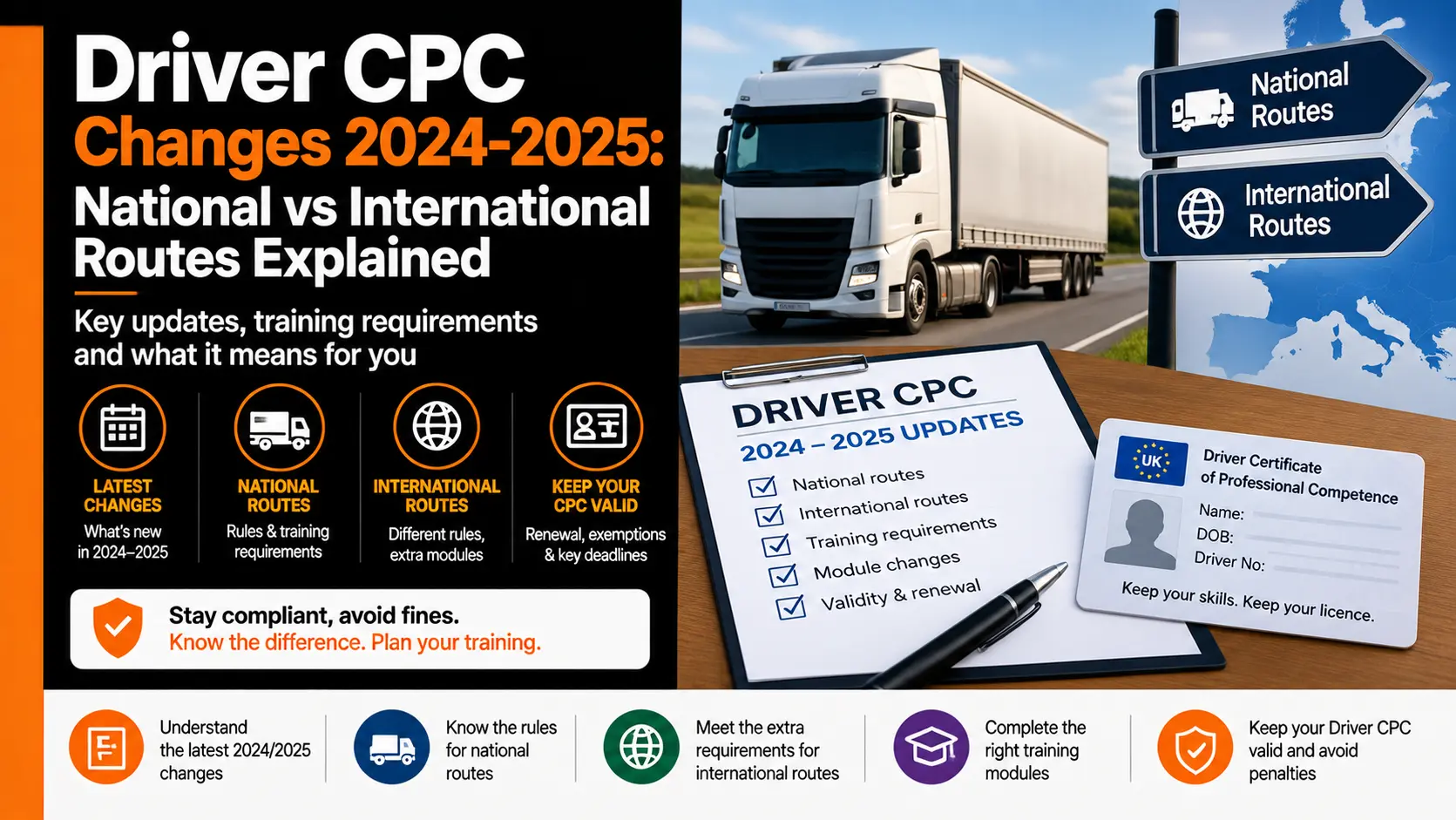
Here’s the short version: Driver CPC hasn’t gone anywhere. The driver CPC changes 2024 reforms split the qualification into two distinct routes National and International giving UK-only drivers more flexibility while keeping the existing rules intact for anyone crossing into Europe. Whether that matters to you depends entirely on where you actually drive.
This guide walks through what changed, when, and which route fits your situation, based on current GOV.UK guidance.
What Changed to Driver CPC in 2024 and 2025?
Two separate sets of changes landed roughly two months apart, and mixing them up is where most of the confusion starts.
Changes Introduced in December 2024
From 3 December 2024, drivers could choose between two ways of staying qualified: National Driver CPC or International Driver CPC. Before this date, everyone followed the same training structure regardless of where they drove.
The practical shift for UK-only drivers is real. National training courses can now run in blocks as short as 3 hours 30 minutes, rather than the previous 7-hour minimum. E-learning was also decoupled from trainer-led sessions, so some modules can be completed entirely online up to a combined limit of 12 hours across the full 35-hour requirement.
None of this touches the total hours needed. It just changes how those hours can be delivered.
Changes Introduced in February 2025
The second wave, effective 1 February 2025, dealt with drivers whose CPC had lapsed. Previously, anyone returning after expiry faced the same 35-hour requirement as someone qualifying from scratch, a genuine barrier for drivers who’d simply let their card run out during a career break.
Since February 2025, drivers whose CPC expired between 60 days and 2 years ago have faster routes back, including a 7-hour Return to Driving module that lets them get moving again before completing the rest of their hours. Expire for longer than two years, though, and the old full-requirement rules still apply.
National vs International Driver CPC: What’s the Difference?
The distinction sounds bureaucratic until you realise it decides where you’re legally allowed to work.
National Driver CPC
National CPC covers professional driving within the UK only lorries, buses and coaches, but nothing that crosses into the EU. It still requires the full 35 hours of training every five years; what’s changed is the flexibility around how you get there.
Courses can run in 3.5-hour blocks rather than full-day sessions, which matters if you’re trying to fit training around shift patterns rather than taking a day off. Driver CPC national routes training also allows a heavier lean on e-learning, up to the 12-hour cap, so operators running large domestic fleets can schedule training with far less disruption than before.
International Driver CPC
International CPC is simply the old system under a new name. If you drive professionally in the UK and the EU, this is your only option; there’s no shortcut here.
Courses must still run for a minimum of 7 hours, and the same 12-hour e-learning cap applies. Driver CPC international routes haven’t been simplified because the underlying EU-facing regulations haven’t changed; the reform was specifically aimed at giving domestic drivers more breathing room.
National vs International Driver CPC at a Glance
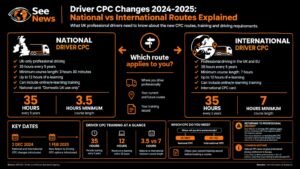
| Requirement | National CPC | International CPC |
| Driving scope | UK only | UK and EU |
| Periodic training | 35 hours / 5 years | 35 hours / 5 years |
| Minimum course length | 3h 30m | 7h |
| E-learning limit | Up to 12 hours | Up to 12 hours |
| Card wording | “Domestic UK use only” | International (unchanged format) |
Which Driver CPC Do You Need?
If you only drive in the UK, National CPC is the obvious fit. You get shorter, more flexible training blocks and don’t pay for a qualification you’ll never use.
If you drive from the UK to Europe, you need International CPC full stop. There’s no version of National training that lets you legally drive professionally across the Channel.
If you only occasionally drive abroad, don’t be tempted to save time with National training. One EU trip is enough to require the International qualification, and getting caught without it carries real risk.
If your routes could change later, think ahead before booking. Switching from National to International down the line means starting your International hours from scratch National hours don’t carry across.
How Many Driver CPC Hours Do You Need?
The 35-hour requirement hasn’t moved, whichever route you take. What’s changed is the shape of those hours.
- National CPC course length: minimum 3 hours 30 minutes per session, giving far more scheduling flexibility for driver CPC workplace training.
- International CPC course length: minimum 7 hours per session, unchanged from the pre-2024 rules.
- E-learning limit: up to 12 hours of the 35 can be completed through driver CPC distance education, on either route.
The remaining hours still need proper trainer-led delivery, whether that’s classroom-based or driver CPC on-site training at a depot. E-learning is a supplement, not a replacement for the whole course.
Can You Complete Driver CPC Training Online?
Partly not entirely. National CPC now allows more of the 35 hours to be delivered online than before, but the 12-hour e-learning cap applies regardless of route.
International CPC follows the same cap, but the minimum 7-hour trainer-led session structure limits how much can shift online in practice. A reputable driver CPC training provider will be upfront about which portions of a course are e-learning and which require live attendance.if a provider claims you can do all 35 hours from your sofa, that’s a red flag.
Always check that a provider is DVSA-approved before booking. Unapproved training simply doesn’t count, no matter how convincing the course looks.
What Happens If You Choose the Wrong CPC?
Booked National CPC but now need to drive in Europe? You’ll need to complete 35 hours of International CPC training separately. National hours don’t convert or top up an International qualification.
Can National and International training be mixed? Not in the way some drivers assume. If any National courses are included in your periodic training, you end up with a National CPC even if you also took some International modules. There’s no blended qualification that lets you drive in both.
Already completed National training and now need International? You’re not starting from zero in terms of skill, but you are starting from zero in terms of hours. The International 35-hour requirement has to be met in full using approved International courses.
What Happens If Your Driver CPC Has Expired?
If Your CPC Expired Between 60 Days and 2 Years Ago
You now have a genuine choice. Take the full 35 hours of International or National training to requalify outright, or use the faster route: a 7-hour Return to Driving module gets you back on the road, with the remaining 28 hours to be completed within 12 months.
If Your CPC Expired More Than 2 Years Ago
The shortcut doesn’t apply. You’ll need the full 35-hour requirement before driving professionally again, on whichever route matches your work.
What Is the 7-Hour Return to Driving Module?
It’s a single session designed to get lapsed drivers back working quickly, rather than forcing them to sit out an entire 35-hour course before earning a wage again. It buys time, not a permanent exemption; the remaining hours are still owed.
What Driver CPC Exemptions Apply?
Who May Be Exempt From Driver CPC?
Not every person behind the wheel of a lorry or bus needs a Driver CPC. GOV.UK’s exemptions guidance sets out exemptions for non-commercial carriage, certain agricultural and forestry work, driving lessons, and journeys to pre-booked MOT-style testing appointments.
What Is the 100km / 62-Mile Exemption?
This is the one that trips people up most. The rule covers driving within 62 miles (100 kilometres) of your base not 100 miles, a mix-up that circulates constantly online. Even within that distance, the vehicle can’t be carrying passengers or goods, and driving a lorry, bus or coach can’t be your main job.
What Conditions Apply?
Several exemptions also require that driving makes up less than 30% of your rolling monthly working time a mechanic occasionally moving vehicles for testing, for instance, rather than someone driving professionally most days.
What About Drivers Who Only Occasionally Drive?
Occasional driving doesn’t automatically mean exemption. Every case depends on the specific combination of distance, cargo, and how central driving is to the job; there’s no blanket rule for “part-time” drivers. When in doubt, check your exact circumstances against GOV.UK’s guidance on when you don’t need Driver CPC.
What Does Domestic UK Use Only Mean?
Drivers who requalify or renew under National CPC now receive a card marked “DOMESTIC UK USE ONLY.” It’s a visible flag for the driver, employer, and any roadside enforcement check that the holder isn’t qualified for EU professional driving.
International CPC cards keep the previous format, without that restriction printed on them. Older cards issued before December 2024 remain valid under their original terms until renewal brings the driver into the new system.
HGV and PCV Driver CPC Requirements
HGV and PCV (bus and coach) drivers both sit under the same National/International framework, with the same 35-hour requirement and the same exemption rules. One set of periodic training can cover a driver who works across both lorry and bus categories, provided the training itself meets the applicable approval standards for the licences held.
They’re not identical in every practical respect, route patterns and typical training providers differ but the underlying CPC rules don’t create separate tracks for HGV versus PCV drivers.
Common Driver CPC Mistakes to Avoid
- Assuming Driver CPC has been scrapped. It’s been restructured, not removed.
- Booking National CPC when International is actually needed is a costly mistake to unwind.
- Assuming all training can be done online. The 12-hour e-learning cap is firm.
- Forgetting the 12-hour e-learning limit when stacking multiple online modules.
- Assuming National hours automatically upgrade to International. They don’t.
- Ignoring the CPC expiry date until it’s already lapsed.
- Relying on pre-2024 information found through a quick search, without checking it against current GOV.UK guidance.
Driver CPC Examples: Which Route Applies?
Example 1 UK-only HGV driver: Delivers between UK warehouses only. National CPC fits, with the flexibility of shorter course blocks.
Example 2 UK to France driver: Runs regular freight into Europe. International CPC is required, no way around it.
Example 3 Driver who may start European routes: Currently UK-only but expects EU work within the year. Worth considering International CPC now to avoid retraining later.
Example 4 Driver returning after an expired CPC: Lapsed 14 months ago. Qualifies for the fast-track Return to Driving option under the 2025 changes.
Driver CPC Checklist Before Booking Training
- Confirm whether your work is UK-only or includes EU routes
- Check your current CPC status and card type
- Note your exact expiry date
- Tally hours already completed, if any
- Decide National or International based on actual routes, not convenience
- Check how many e-learning hours you’ve already used
- Confirm the training provider is DVSA-approved
- Consider whether your routes are likely to change soon
Conclusion
Driver CPC didn’t disappear in 2024.it split into two clearer paths. National CPC suits UK-only professional drivers and comes with genuinely useful flexibility around training format. International CPC remains the only option for anyone driving professionally into Europe, unchanged in its core structure.
Before booking anything, check your actual routes, your current CPC status, and your card type. Exemptions exist but depend heavily on individual circumstances, so don’t assume one applies without checking the specifics. Get the route right first, and the rest of the process is far more straightforward.
For UK drivers trying to keep up with changes like this, Seenews will keep covering the practical detail behind the headlines so the next reform doesn’t catch you out either.