Picture an English lead sitting down with a fresh 150-page document. Where do you even start? That’s the reality for a lot of primary schools right now.
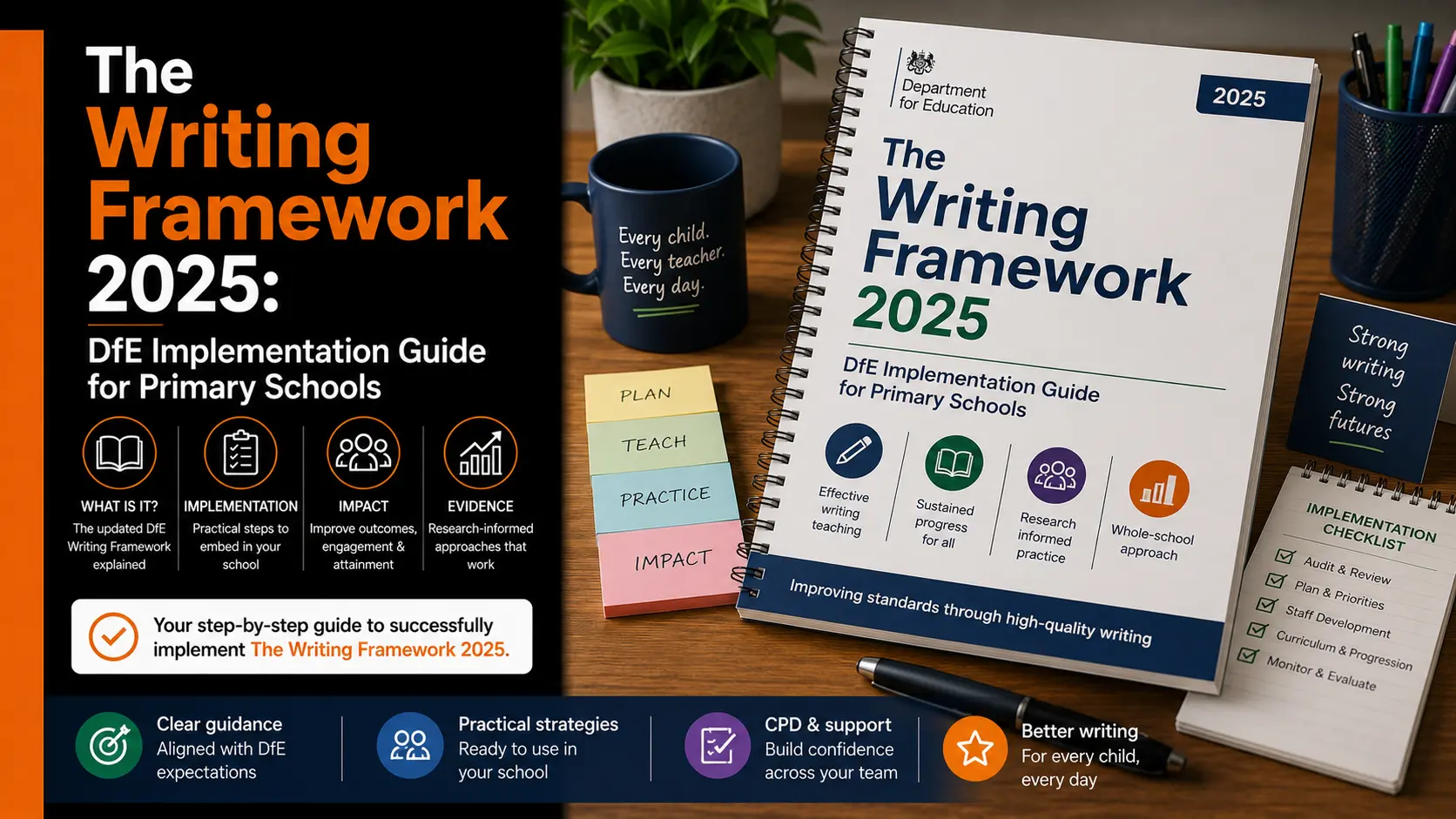
The writing framework 2025 landed in July with real ambition behind it. Reading it is one thing. Doing something useful with it is another matter entirely.
This guidance sets out how writing should be taught, from Reception right through to Year 6. It’s built on evidence, not opinion. It matters because writing standards have stalled for years, and disadvantaged pupils have been hit hardest. But knowing the framework exists isn’t the same as knowing what to actually change on Monday morning.
So here’s what the framework says, what it means for each year group, and how leaders can turn 150 pages of guidance into something teachers can genuinely use.
What Is the Writing Framework 2025?
It’s DfE guidance explaining how children learn to write well. It also sets out what strong teaching looks like at each stage of primary school.
Why Has the DfE Introduced the Framework?
Writing has lagged behind reading for years now. In 2025, the DfE reported that only 59% of disadvantaged pupils met the expected standard in writing at the end of Key Stage 2, against 78% of their peers. That’s a big gap, and it doesn’t close on its own.
The framework follows the same logic as the 2023 Reading Framework. Give teachers a clear structure backed by evidence. Don’t leave the teaching of writing to guesswork.
Who Does the Framework Apply To?
Primary schools in England, covering Reception, Key Stage 1 and Key Stage 2. The writing framework 2025 DfE guidance also speaks to teacher training providers and early years practitioners, since it reaches into writing framework EYFS territory before formal schooling even begins.
Reception teachers will find plenty of oral language and early mark-making here, much of it sitting alongside the existing Development Matters guidance for early years settings. KS1 and KS2 teachers get more on spelling, sentence work and composition.
Is the Writing Framework Statutory?
No, it isn’t. This is guidance, not a legal requirement. It doesn’t replace the National Curriculum’s statutory writing content, and schools aren’t breaking any rules by choosing not to follow parts of it.
Still, it’s worth being honest here. It shows how writing gets taught well right now, and it’s likely to shape future changes to the National Curriculum.
What Are the Main Priorities of the Writing Framework?
The framework organises writing into a handful of connected areas, from early mark-making through to independent composition. None of these sit in isolation, and that’s worth keeping in mind as you read through them.
Strong Writing Foundations From Reception
Everything starts here, really. The writing framework early years guidance places heavy emphasis on writing framework mark making and writing framework fine motor skills, and correct writing framework formation of letters matters from the very beginning too.
A lot of Reception classrooms already do a version of this through continuous provision. What the framework pushes for is being more deliberate about it: building hand strength, developing pencil control, and moving toward writing framework independence rather than leaning on adult scribing. Oral language and vocabulary feed into all of this too, whether anyone calls it “writing” yet or not and this is exactly why handwriting can’t be treated as a separate, later concern.
Handwriting and Transcription
Writing framework handwriting gets serious attention as a direct continuation of that early foundation, and honestly, it should. If forming letters takes conscious effort, there’s less mental space left over for choosing words or structuring ideas. Writing framework transcription covers handwriting and spelling together, and both need teaching clearly from Reception onward, so working memory stays free for composition later instead of getting used up on the mechanics.
Spelling picks up where transcription leaves off. Writing framework phonics knowledge underpins writing framework spelling, especially in the early years, since children who can match sounds to letters spend less time guessing how a word is built. It needs the same clear, structured teaching that reading gets, rather than being left to develop on its own.
Once those mechanics are secure, the framework turns to how words get arranged into sentences. Writing framework sentence construction sits right at the centre of the guidance, and pupils need practice building sentences of increasing complexity before they’re expected to produce whole pieces of extended writing. Writing framework punctuation gets taught in context alongside this, not as a set of disconnected rules memorised for a test.
That whole chain, letters, spelling, sentences, finally arrives at writing framework composition, where everything else pays off. Ideas turn into coherent, purposeful writing. The framework encourages oral rehearsal, meaning pupils say a sentence aloud before writing it down, and that single habit catches a surprising number of errors before the pen even touches paper.
What Does the Framework Mean for Teachers?
| Stage | Main focus |
| Reception / EYFS | Mark-making, fine motor skills, oral language, early letter formation |
| Year 1–2 | Transcription, spelling, sentence construction, handwriting consistency |
| Year 3+ | Fluency, vocabulary, paragraph structure, editing, independence |
What Does It Mean for Reception and EYFS?
More purposeful mark-making, stronger fine motor development, and earlier, more structured letter formation teaching. Oral language stays central throughout, and independence builds gradually rather than being expected overnight. From there, the demands only grow.
What Does It Mean for Year 1 and Year 2?
In writing framework year 1 and writing framework year 2 classrooms, transcription and spelling need teaching consistently, alongside developing sentence construction. Composition stays closely tied to what pupils can already manage at sentence level, since extended pieces attempted before the basics are secure tend to come out long but shaky. Better to build the foundation properly than rush toward length.
What Does It Mean for Year 3 and Beyond?
By writing framework year 3 and through the rest of KS2, that foundation gets put to work. The focus shifts toward fluency, expanding vocabulary, and refining sentence and paragraph structure. Editing becomes a genuine part of the process rather than an afterthought, and independence should be fairly well established by this point, since so much groundwork has already gone in.
Why Are Handwriting, Spelling and Sentence Skills So Important?
Writing is genuinely hard work for a young brain. A child juggles letter formation, spelling, grammar, and meaning all in one sentence, and working memory can only hold so much at a time.
Fluent handwriting frees up space in a child’s mind, and so does spelling that comes without thinking hard about it. Practising sentence building on its own, before it’s needed inside longer pieces, does something similar.
None of this points to one teaching method as the only right way. The framework offers ideas to work from, not a script to copy word for word.
What Does Quality Over Quantity Mean for Writing?
Not writing less overall. It means building genuine skill before piling on volume.
Extended writing still matters a great deal, and the framework isn’t quietly dropping it. What’s changing is the order things happen in: secure transcription, spelling and sentence-level skills first, so pupils aren’t fighting the basics while also trying to organise their thinking. Teachers can strike this balance by asking for shorter, more careful pieces early on, then building up length as fluency grows.
How Should Schools Support Struggling Writers and SEND Pupils?
Early identification matters most. Transcription difficulties tend to show up quickly, provided teachers are watching for them rather than waiting until a child is visibly behind.
Practical support might include extra practice with letter shapes or spelling patterns, adapted teaching that eases the load on working memory, and more time for transcription so composition doesn’t feel rushed. Every school’s SEND provision looks different, but catching problems early matters most, since gaps tend to grow rather than fix themselves.
Does the Writing Framework Change Writing Assessment?
Writing framework assessment shifts the focus toward genuine progression. Are sentences becoming more varied? Is spelling more secure? Is composition more purposeful? Those questions matter more than a narrow fixation on how much a child has written.
This sits comfortably within the ongoing assessment already happening in most schools. Writing framework progression should be visible across a pupil’s work over time. A shorter piece with strong sentence control genuinely tells you more than a long one full of the same repeated patterns.
Does the Writing Framework Replace the National Curriculum?
No. The National Curriculum sets out what schools must teach, and the writing framework national curriculum relationship works alongside that, offering guidance on how to teach writing well within those requirements.
Schools don’t need to tear up existing curriculum plans. Better to audit first: check where current practice already lines up, and find the real gaps, before making wholesale changes.
What Does the Writing Framework Mean for Ofsted?
The framework itself isn’t an inspection requirement. Inspectors don’t check schools against it directly.
What they do look at is how the curriculum is planned and taught, how well teachers know their subject, and how pupils are progressing. Strong writing provision, built along the lines the framework describes, tends to support exactly what inspectors already care about. Better to focus on genuinely good teaching than to treat this document as a checklist for inspection.
How Can Schools Implement the Writing Framework?
Step 1 Understand the Guidance
Usually the English lead reads the document closely and works out which principles matter most for the school.
Step 2 Audit Current Writing Provision
Look honestly at curriculum sequencing, handwriting, spelling, sentence-level work, composition, assessment, and early years provision. Writing framework planning and writing framework resources both get evaluated here, against what the guidance actually recommends.
Step 3 Identify and Prioritise Gaps
Resist the urge to change everything at once. Pick two or three priority areas based on the audit, rather than attempting a full overhaul in a single term.
Step 4 Support Teachers With CPD
Subject knowledge varies across any staff team, and that’s normal. Teachers need training that builds real confidence, not a single INSET day forgotten by half-term. It’s the same idea behind structured training schemes like the Competence Assessment Programme, used elsewhere in education and regulated jobs.
Step 5 Put Changes Into Classroom Practice
Small, specific changes beat vague ambitions: five minutes of daily handwriting practice, or oral rehearsal built into every writing lesson.
Step 6 Monitor and Refine
Review pupil work regularly, gather teacher feedback, and adjust based on what you find. Implementation isn’t a single event; it’s an ongoing cycle.
What Should an English Lead Do First?
- Review the existing writing curriculum.
- Audit current provision against the framework’s priorities.
- Review pupil work across year groups.
- Identify the two or three most urgent gaps.
- Plan targeted teacher support.
- Introduce focused, manageable improvements.
- Monitor progress and adjust as needed.
Common Misconceptions About the Writing Framework
The framework is statutory. It isn’t. It’s guidance, not a legal requirement.
It replaces the National Curriculum. It doesn’t. The National Curriculum remains the statutory reference point here.
Schools must replace their writing scheme.Not necessarily. An audit usually reveals which parts already align well.
Quality over quantity means children should write less.It means building skill before volume. Not writing less overall.
Extended writing is no longer important.Still central. What’s changed is the sequencing, not the destination.
Conclusion
Schools don’t need to overhaul everything the week this framework lands on a desk. What matters more is understanding it properly first, auditing existing provisions honestly, and figuring out where the real gaps actually sit.
From there, teacher support and focused classroom changes count for more than sweeping, immediate reform ever will. Review progress. Adjust where needed. Keep going. The framework points toward a clearer way to teach writing well. What actually improves outcomes for pupils is the steady, ordinary work of putting it into practice, one manageable step at a time. SeeNews will keep following how the framework beds in across schools, and what it ends up meaning in practice.