Introduction
A homeowner in Manchester recently spent three weeks trying to figure out whether she needed planning permission for a driveway charger. She didn’t. But the confusion around the ev chargers England regulation change is exactly why the Government stepped in to simplify things. From 2026, the rules around installing home EV chargers in England are shifting, and if you own a driveway, rent a flat, or manage a small fleet, this affects you more than you might think. Here’s what’s actually changing, who it applies to, and what to check before you install anything.
What Is the EV Chargers England Regulation Change 2026?
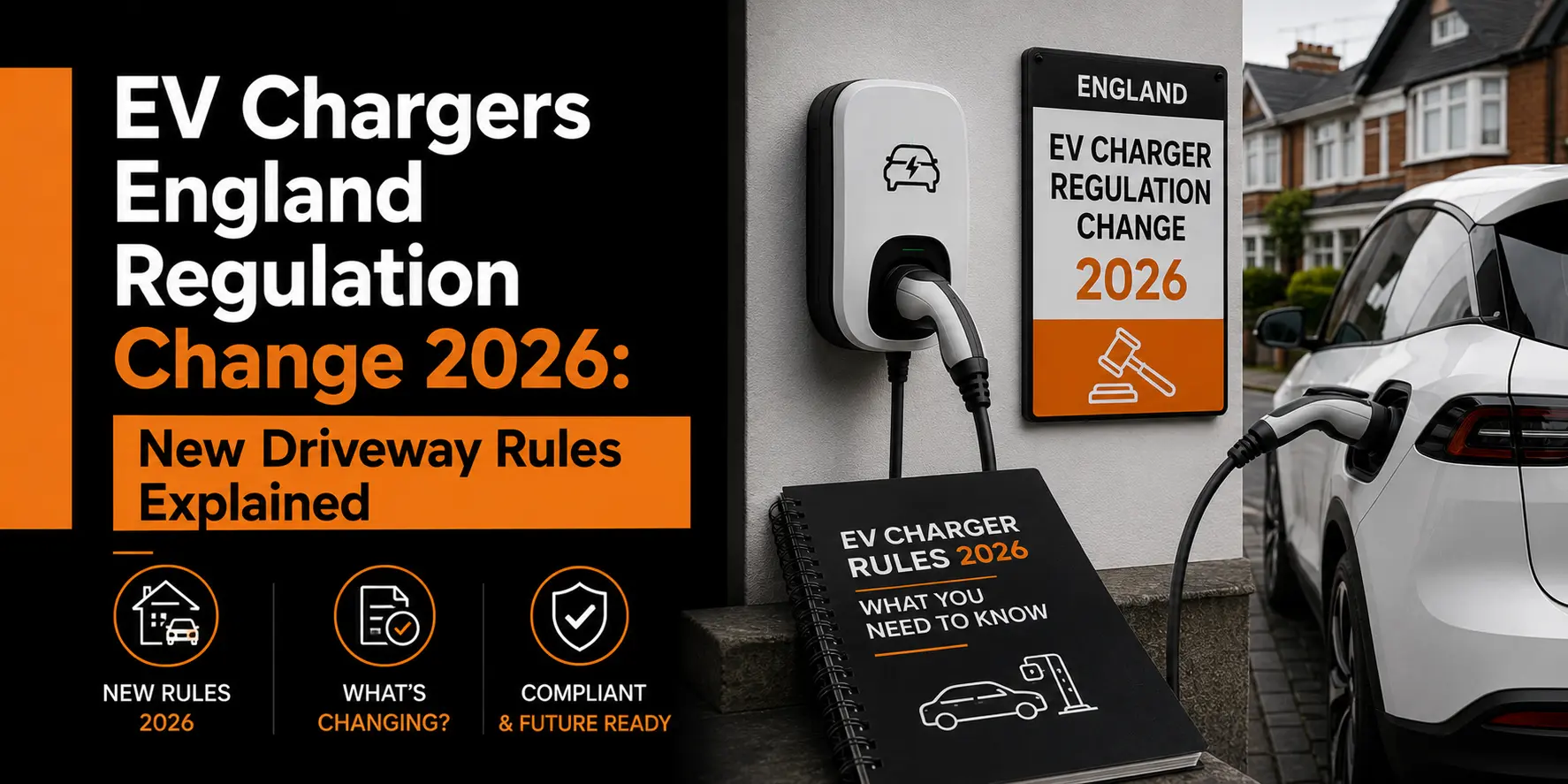
The EV Chargers England Regulation change for 2026 clarifies when planning permission is required, tightens safety standards for domestic electric vehicle charging points, and introduces new rules for cable routing across shared spaces. Ministers introduced these changes because the previous regulations had not kept pace with the rapid growth of the electric car UK second-hand market.
As more households purchase used EVs, many are finding that their local councils lack clear guidance on charger installation.
Why Were the Rules Changed?
Two problems forced the Government’s hand. First, inconsistent council decisions left neighbouring homes with completely different outcomes for near-identical driveway setups. Second, safety concerns around diy and poorly certified installations pushed regulators toward tighter compliance standards.
The result is a framework that’s stricter on safety but, in most cases, simpler for homeowners.
Who Is Affected by the New Rules?
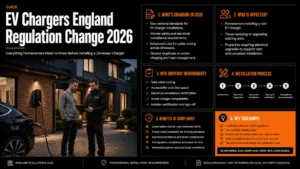
- Homeowners installing a private charger for the first time
- Landlords managing rental properties with driveways
- Tenants who want a charger but need landlord consent
- Businesses installing fleet services ev chargers on commercial land
- Local authorities responsible for approving cross-pavement installations
If you fall into any of these categories, the details below matter.
What’s Actually Changed for EV Charger Installations?
Planning Permission
Most standard driveway installations still won’t need planning permission. That hasn’t changed. What has changed is the criteria council officers use to decide when an exception applies: height, position near a boundary, and visibility from the road all now carry clearer thresholds.
Cross-Pavement Charging
If you don’t have off-street parking, running a cable across a public footpath used to sit in a legal grey area. The 2026 rules formalise this through approved cable gully systems, giving councils a standard method to approve rather than reject these requests outright.
Smart Charger Requirements
Nearly all new domestic installations must now meet smart EV charging standards, meaning the charger can communicate with the grid and shift charging to off-peak hours automatically. This isn’t just about convenience.it’s designed to ease pressure on local electricity networks as adoption grows.
Does This Apply to Your Property?
Not every property type is treated the same way.
- Detached and semi-detached houses straightforward in almost all cases
- Terraced homes may need cable routing checks if parking is on-street
- Flats and leasehold properties require freeholder or management company consent
- Listed buildings and conservation areas still need planning approval regardless of the new simplifications
- Shared driveways need written agreement from all parties before installation
If you’re renting, your landlord’s consent remains the deciding factor, not the council.
Do You Still Need Planning Permission?
In most standard cases, no. You won’t need approval if the charger sits below a set height, isn’t installed on a wall facing a highway in a conservation area, and doesn’t require groundworks on shared land.
You will still need approval if you live in a listed building, sit within a conservation area, or share access with neighbours who haven’t agreed to the installation.
What If You Don’t Have a Driveway?
This is where most confusion comes from. Homes without off-street parking have three realistic paths: a council-approved cable gully for pavement charging, reliance on public ev charger near me networks, or workplace and community charging schemes.
None of these routes require you to own a driveway, but each comes with its own approval process and cost structure.
How Do You Actually Install One?
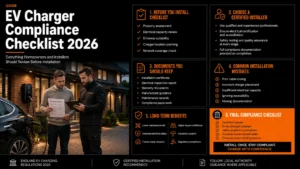
- Confirm your property’s eligibility with your local council
- Get an electrician to assess your consumer unit and electrical capacity
- Choose between tethered vs untethered ev chargers based on your vehicle and driveway layout
- Check your eligibility for electric vehicle charger grant support
- Hire a certified installer registered with a recognised competent person scheme
- Get the installation tested and certified before use
Skipping step two is the most common reason installations fail inspection. Older homes often need a consumer unit upgrade before a charger can be safely connected.
What Financial Support Is Available?
Government grants for ev chargers at home haven’t disappeared, despite what some homeowners assume. Support is still available for renters, flat owners, and landlords installing chargers on qualifying properties, though the amount and eligibility criteria vary by scheme.
Businesses installing multiple units can access separate funding aimed at workplace and fleet charging infrastructure.
What Does Installation Actually Cost?
A standard home ev charger station typically costs between £800 and £1,200 fitted, though this varies based on cable routing and existing electrical capacity. Add-on costs worth budgeting for include:
- Consumer unit or fuse upgrades
- Groundworks for cable routing
- Cable gully installation for pavement crossings
- Planning-related fees, where applicable
Homes with older wiring almost always face higher costs than newer builds.
Common Mistakes Homeowners Make
One of the biggest mistakes homeowners make is assuming the EV Chargers England Regulation Change applies the same way to every property. A neighbour’s approval doesn’t guarantee yours, especially across different house types or conservation zones. Other frequent errors include ignoring future charging needs, hiring installers without proper certification, and overlooking local restrictions that only apply within specific postcodes.
Busting a Few Myths
Everyone needs planning permission now. Not true most standard installations still don’t.
You can’t own an EV without a driveway. Public and workplace charging make ownership entirely possible without one.
Grants have ended. They haven’t, though eligibility has narrowed in some regions.
Frequently Asked Questions
What are the new EV charger driveway rules in England in 2026?
The rules clarify when planning permission is needed, introduce approved cable gully standards for pavement charging, and require most new installations to meet smart charging standards. Most standard driveway installations still won’t need council approval.
Do I still need planning permission to install an EV charger on my driveway in 2026?
In most cases, no. You’re exempt if the charger sits below a set height and isn’t fixed to a wall facing a highway in a conservation area. You’ll still need approval if you live in a listed building, a conservation area, or share access with neighbour who haven’t agreed to the installation.
How much is the government EV charger grant in 2026, and am I eligible?
Grant amounts vary by scheme and property type, so there’s no single flat figure. Renters, flat owners, and landlords can all still apply, though eligibility criteria differ. it’s worth checking current funding levels directly with the relevant scheme before booking an installer.
What is smart charging and is it mandatory for home EV chargers in England?
Smart charging lets your charger communicate with the electricity grid and automatically shift charging to off-peak hours. Under the 2026 rules, nearly all new domestic installations must meet this standard, so it’s effectively mandatory for new setups.
I live in a listed building or conservation area; can I still install an EV charger?
Yes, but you’ll need planning approval regardless of the wider 2026 simplifications. Listed buildings and conservation areas are specifically excluded from the relaxed permission rules that apply to standard properties.
I’m a renter or live in a flat; what do the 2026 rules mean for me?
Your landlord or freeholder’s consent remains the deciding factor, not the council. The good news is that grant support is still available for renters and flat owners, so cost doesn’t have to be the main barrier getting sign-off from your landlord is usually the bigger hurdle.
What type of EV charger do I need to comply with the 2026 rules?
Your charger needs to meet smart charging standards as a baseline. Beyond that, choosing between a tethered or untethered unit comes down to your vehicle and driveway layout rather than compliance. Both types can meet the new rules.
How much does it cost to install an EV charger on a driveway in England in 2026?
A standard installation typically runs between £800 and £1,200, depending on your electrical capacity and cable routing needs. Older properties often face higher costs due to consumer unit upgrades, so it’s worth getting an electrician’s assessment before budgeting.
Can my neighbours run an EV cable across a shared path under the new rules?
Only with a council-approved cable gully system and written agreement from everyone with access to that shared path. The 2026 rules formalise this process, but it still requires proper approval an unauthorised cable across a shared route isn’t compliant.
Conclusion
The EV Chargers England Regulation changes for 2026 make driveway charging clearer for most homeowners while tightening safety and smart charging standards across the board. Before installing anything, check your property type against council guidance, confirm your electrical capacity, and verify grant eligibility.
Rules like these shift often, which is why Seenews is worth bookmarking. It tracks UK transport and infrastructure policy and turns updates like this into guidance you can actually act on.
Check the latest Government guidance before booking an installer. Getting the EV Chargers England Regulation right the first time saves more than a quick check beforehand.