Open your first Self Assessment bill and there’s usually a number sitting next to your Income Tax that nobody warned you about. That’s Class 4 NIC, and many self-employed people don’t understand how it’s calculated.
Here’s the short version: it’s based on what you actually kept after expenses, not what your business turned over.
This guide covers current rates and thresholds, how the sums work, where Class 2 fits in, what it means for your pension, and the mistakes that catch people out most often.
What Is Class 4 National Insurance?
A charge on the profits of self-employed people, collected through Self Assessment alongside Income Tax.
Who Normally Pays Class 4 National Insurance?
Sole traders, freelancers, contractors, consultants, and business partners. Anyone running a self-employed business with profits above the threshold falls into this group.
Is Class 4 National Insurance the Same as Income Tax?
No. They’re separate charges that happen to land on the same bill, calculated using different rules even though both start from your self-employed profit. If your profits clear the threshold, you’re in scope regardless of what else appears on your return.
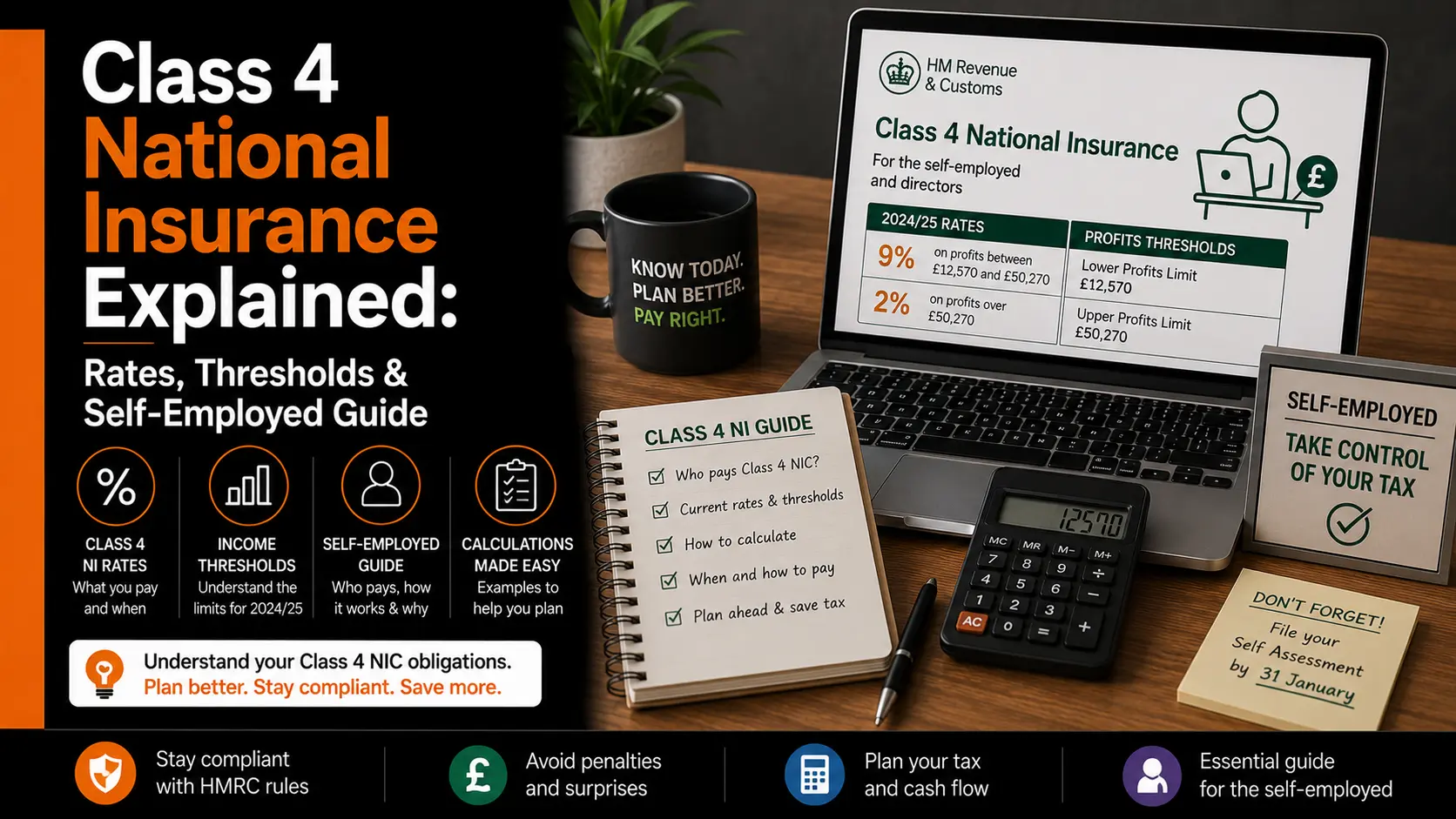
Class 4 NIC Rates and Thresholds for 2026/27
| Relevant self-employed profits | Rate |
| Up to £12,570 | 0% |
| £12,570 to £50,270 | 6% |
| Above £50,270 | 2% |
What Is the Class 4 NIC Threshold?
The Lower Profits Limit sits at £12,570 for 2026/27. Profit below that doesn’t attract any Class 4 charge.
What Is the Class 4 NIC Upper Threshold?
Past £50,270, the rate drops to 2% on everything above it. That’s lower than the 6% band underneath, mirroring how employee National Insurance works.
What Does the Nil Rate Mean?
A 0% rate on your first £12,570 sounds like a free pass. It isn’t quiet. You might still owe Income Tax depending on your personal allowance, and you may still need to file a return.
How Is Class 4 NIC Calculated?
Business income, minus allowable expenses, equals taxable trading profit, the figure Class 4 is actually applied to.
Is It Based on Profit or Turnover?
Profit, not turnover. A business billing £80,000 with £60,000 of costs pays Class 4 on £20,000, not £80,000. Mixing these up is one of the most common misunderstandings.
Can Allowable Expenses Reduce the Amount?
Yes, since they reduce profit before Class 4 applies. Common examples: business travel, professional fees, office costs, equipment, and a reasonable share of home-working costs. Not every cost qualifies, and personal expenses dressed up as business ones won’t survive scrutiny.
Can Tax Reliefs Affect the Calculation?
Some can, though it’s worth keeping Class 4 relief separate from Income Tax relief in your head. They don’t always work the same way.
Class 4 NIC Calculation Examples
£10,000 profit: Below the £12,570 threshold. No Class 4 due.
£20,000 profit: £7,430 sits in the 6% band. That’s £445.80.
£40,000 profit: £27,430 sits in the 6% band. That’s £1,645.80.
£55,000 profit: The full £37,700 between £12,570 and £50,270 is taxed at 6%, giving £2,262. The remaining £4,730 above £50,270 is taxed at 2%, adding £94.60. Total: £2,356.60. Nobody pays the top rate on their whole profit, only the slice above £50,270.
£100,000 profit: The 6% band maxes out at £2,262. The remaining £49,730 above £50,270 gets taxed at 2%, adding £994.60. Total: £3,256.60.
Class 4 NIC and Class 2: What’s the Difference?
Class 2 used to be a flat weekly charge protecting your State Pension record. That compulsory charge was scrapped from April 2024. Class 4 is the profit-based charge covered throughout this guide, and it’s the one that still costs most self-employed people actual money.
Do Self-Employed People Still Pay Class 2?
Not compulsorily, for most people. If profits sit at or above the Small Profits Threshold of £7,105, Class 2 is treated as paid automatically. Below that, you can pay it voluntarily at £3.65 a week to protect your record.
What Does Class 2 Treated as Paid Mean?
No money changes hands, but HMRC credits your record as though it had, provided your profit clears £7,105.
Which Class Affects Your National Insurance Record?
This is where the two genuinely diverge. Class 2, or being treated as having paid it, is what builds your record. Class 4 doesn’t do that job at all, which surprises people who assume paying more automatically means more pension credit.
Does Class 4 NIC Count Towards Your State Pension?
No. Class 4 and State Pension entitlement aren’t directly linked, and this is misunderstood constantly.
Does Paying Class 4 Automatically Give You a Qualifying Year?
No, and this catches a lot of people out. That job belongs to Class 2, or the credit for being treated as having paid it.
What If Your Profits Are Low?
If profit falls below the £7,105 threshold, you won’t automatically get a qualifying year. Paying Class 2 voluntarily at £3.65 a week is a cheap way to protect that year.
How Can You Check Your National Insurance Record?
Through your personal tax account on GOV.UK. It shows qualifying years and flags gaps before you decide whether voluntary contributions make sense.
What If You Are Both Employed and Self-Employed?
Do You Pay Class 4 If You Already Pay Class 1?
Yes. Having a PAYE job doesn’t exempt your self-employed profits from Class 4. The two run independently.
Do You Pay National Insurance Twice?
Not for the same pound. You pay Class 1 on salary and Class 4 on self-employed profit separately, though safeguards exist against excessive overlap in high-earning combined cases.
Example: PAYE Salary Plus Self-Employment Profit
Someone earning £35,000 through PAYE and £15,000 from a side business pays Class 1 through their employer as normal, and Class 4 on the self-employed profit above £12,570, worked out through Self Assessment.
How and When Do You Pay Class 4 NIC?
Is Class 4 Included in Self Assessment?
Yes. It’s worked out automatically once you enter your profit figures, sitting alongside Income Tax on the same calculation.
When Is the Payment Due?
Generally by 31 January following the end of the tax year, the same deadline as your main Self Assessment balance.
What Happens If You Miss the Deadline?
Interest and penalties can apply, so it’s worth budgeting for well ahead of time.
Why Is Your First Self Assessment Bill Higher Than Expected?
Your first bill often includes both Income Tax and National Insurance, which makes the total look bigger than people mentally prepared for.
What Are Payments on Account?
Advance payments toward next year’s tax bill, based on this year’s liability, split into two instalments. Yes, Class 4 is factored into this calculation too, not just Income Tax.
Why Can the First Bill Feel Like Two Years’ Tax?
Because it often is, in a sense. You’re paying this year’s liability plus the first payment on account toward next year, all in one go. It’s an advance payment, not an extra tax charge.
How Can Self-Employed People Prepare for the Bill?
Set aside a percentage of profit as it comes in, rather than waiting until January to work out what you owe.
What Happens If Your Business Makes a Loss?
No Class 4 is due on a loss, since there’s nothing for the charge to apply to. Loss relief can reduce your Class 4 position in certain circumstances, depending on how losses are used against other income or carried forward. The specifics depend on your situation, so this is worth checking properly rather than assuming.
What About Special Class 4 NIC Situations?
There’s no blanket exemption for self-employed people generally, though specific circumstances can affect liability. New self-employed people sometimes assume their first year works differently. It doesn’t, in terms of rate structure, though the first bill may include payments on account, which catches people off guard.
Deferment applies only in narrow circumstances, generally where someone runs multiple income sources risking excess contributions. Not a general option for anyone who’d simply rather pay later.
Marriage Allowance affects Income Tax, not National Insurance, so it doesn’t touch your Class 4 bill either way. Your Income Tax personal allowance works the same way here: separate from Class 4, which uses its own threshold structure entirely.
Common Class 4 NIC Mistakes and Misconceptions
Class 4 NIC is based on turnover.It isn’t. Relevant profits are the starting point, after expenses.
Class 4 is the same as Income Tax.They’re calculated separately, even on the same bill.
I have a PAYE job, so I don’t pay Class 4.Employment doesn’t remove your self-employed obligations.
Paying Class 4 gives me a State Pension qualifying year.Nope. That’s Class 2’s role.
Everything above the upper threshold is charged at the same rate.Only the slice above £50,270 gets 2%.
Payments on account are an extra tax.Not quite. They’re advance payments toward a future liability.
Class 1, Class 2, Class 4 and Income Tax: What’s the Difference?
| Charge | Generally associated with |
| Class 1 | Employment |
| Class 2 | Self-employed National Insurance record rules |
| Class 4 | Self-employed profits |
| Income Tax | Taxable income |
Class 1 comes from employment income through PAYE. Class 2 protects your National Insurance record. Class 4 is a profit-based charge with no direct pension link. Income Tax and Class 4 both use your profit as a starting point, but they’re calculated using entirely separate rules and bands.
Class 4 NIC Checklist Before Filing Self Assessment
- Calculate total self-employed income
- Identify allowable business expenses
- Calculate taxable profit
- Check the relevant Class 4 thresholds
- Check your Class 2 position
- Include employment income if applicable
- Review your National Insurance record
- Check payments on account
- Keep supporting records
- Review the return before submitting it
Keeping solid records matters beyond Class 4 too. HMRC has been tightening scrutiny of self-employed and business tax claims generally, including its growing use of AI to check claims like R&D relief, so evidence for every figure on your return is worth holding onto well past filing day.
Conclusion
Class 4 National Insurance comes down to one thing above everything else: your relevant self-employed profit, not your turnover and not your Income Tax bill. Getting the thresholds right matters, but so does remembering that Class 4, Class 2 and Income Tax are three separate calculations sharing one Self Assessment return.
Expenses, employment income, losses and payments on account can all shift your final position. Rates change most tax years, so check current HMRC guidance before relying on any figure, including the ones here. Set money aside as profit comes in, not in January, and the process stops feeling like a surprise. SeeNews will keep tracking these rates and rules as they shift, so you’re not caught out at the next Self Assessment deadline.