Dan works full time and has started freelancing on the side. A friend told him to “sort the self cert form” before his earnings grew. He searched for a self cert form HMRC, found nothing that fitted, and wondered what he’d missed.
He’s missed nothing. No such form exists for declaring trading income, and the confusion is completely understandable. Dan almost certainly needs Self Assessment and the £1,000 Trading Allowance. Both work the same way in tax years 2024/25 and 2025/26, and a tax year runs from 6 April to 5 April.
Is There a Self-Cert Form for Self-Employment?
No. HMRC has no general self-employed certificate form for trading income. You report it through Self Assessment.
What Does Self-Certification Mean?
It means confirming something yourself without proof. Most people know it from sick leave, when an employee tells their employer they were ill for up to seven days. It has nothing to do with tax on side income.
Self-Certification vs Self Assessment
| Term | What it means | Relevant to side income? |
| Self-certification | Confirming sickness absence yourself | No |
| Self Assessment | HMRC’s system for reporting income not taxed through PAYE | Yes |
| Registering as self-employed | Telling HMRC you’re trading so you can file a return | Yes, if over £1,000 |
| Trading Allowance | £1,000 relief on gross trading income | Yes |
A self certification form UK search often lands people in the wrong place. So does a self cert form HMRC search.
What Is the £1,000 HMRC Trading Allowance?
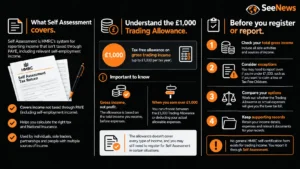
It’s a tax relief on up to £1,000 of gross income from self-employment or casual work in a tax year.
How the Trading Allowance Works?
Each person gets one allowance per tax year. Earn £1,000 or less and you generally get full relief, so you usually owe nothing and report nothing. Earn more and you choose between deducting the £1,000 or deducting actual expenses. It’s called a Trading Allowance because it covers trading income.
Is the £1,000 Based on Income or Profit?
Income, not profit. Gross trading income is everything customers pay you before costs. Profit is what remains after allowable expenses, meaning costs incurred wholly and exclusively for the business.
Sell £1,200 of crafts with £500 of materials and your profit is £700. Your gross income is still £1,200, so you’re over the limit.
Do You Need to Tell HMRC If You Earn £1,000 or Less?
Generally no, but a few situations change that.
What If You Earn Under £1,000?
Say you earn £800 from tutoring. Full relief generally applies, and you usually don’t register or report it.
What If You Earn Exactly £1,000?
You’re still within the allowance. The trigger is gross income of more than £1,000.
What If You Earn £1,001?
That’s over the limit, so you need to register for Self Assessment. You can still claim relief, but you have to report the income.
Are There Exceptions?
Yes. You may want to report if you have a loss to claim, want to pay voluntary Class 2 National Insurance, or already file a return. You’ll also need a return if you want to claim Tax-Free Childcare based on self-employment income. The allowance doesn’t cover every type of income either, as the section on exclusions below explains.
When Do You Need to Register as Self-Employed?
Once your gross trading income passes £1,000 in a tax year.
What Happens When Your Income Goes Over £1,000?
Register for Self Assessment by 5 October after the tax year ends, then file online by 31 January. For 2024/25, that means 5 October 2025 and 31 January 2026. For 2025/26, it’s 5 October 2026 and 31 January 2027. Anyone hunting for a self cert form deadline needs these dates, and GOV.UK lists the current Self Assessment deadlines.
Do You Need to Register for a Small or Occasional Side Hustle?
Yes, if the activity counts as trading and your gross income tops £1,000. A small profit doesn’t change that.
What If You Already Have a PAYE Job?
PAYE is the system where your employer deducts tax from your pay. It doesn’t cover freelance income, so you still need to register. Your steps:
- Track gross income from day one.
- Register for Self Assessment.
- Wait for your Unique Taxpayer Reference (UTR) from HMRC.
- File your return by 31 January.
Trading Allowance or Actual Expenses: Which Should You Use?
Whichever leaves you with the lower taxable profit. Run the numbers both ways before you file, because the gap can run to hundreds of pounds.
When the £1,000 Trading Allowance May Be Better
Earn £1,500 and spend £300. The allowance gives £500 of taxable profit. Actual expenses give £1,200.
When Actual Business Expenses May Be Better
Earn £1,500 and spend £1,400. Actual expenses leave £100 of profit. The allowance leaves £500.
Can You Claim the £1,000 Allowance and Expenses?
Not on the same income. Searches for self cert form business expenses really mean allowable expenses, such as software or stationery. People after self cert form office expenses mean the same thing.
HMRC also offers simplified expenses, which are flat rates for mileage and for working from home (£10, £18 or £26 a month, depending on hours worked). A self cert form flat rate doesn’t exist, but these flat rates sit on the expenses route, never alongside the allowance.
How Do You Claim the Trading Allowance on Your Tax Return?
You enter your income in the self-employment section and choose the allowance instead of listing expenses.
Do You Have to Claim the Allowance?
Under £1,000, full relief generally applies automatically unless you opt out to claim a loss. Over £1,000, you must choose it.
Where Is the Trading Allowance Entered?
Box numbers vary between form versions, so follow the on-screen prompts. Anyone searching for a self cert claim tax return or self cert relief claim wants this section. The self cert form self-assessment question usually boils down to the same thing.
Why Isn’t My £1,000 Allowance Showing?
Common causes:
- You entered expenses instead of choosing the allowance.
- Your income went in the wrong section.
- The allowance doesn’t apply to that income.
- Your income was under £1,000, so nothing needs showing.
What If You Have a Job and a Side Hustle?
Both count towards your overall tax position, but they work differently.
Does Your Salary Affect the Trading Allowance?
No. The allowance stays at £1,000, but your salary decides the rate on any taxable profit.
Is the Trading Allowance the Same as the Personal Allowance?
No. The Personal Allowance (£12,570 for most people) covers your total taxable income, as GOV.UK’s Income Tax rates and allowances page explains. The Trading Allowance only reduces trading income.
Example: PAYE Salary Plus Freelance Income
Sam earns £32,000 through PAYE plus £1,500 freelancing, with £300 of costs. Using the allowance, £500 of profit joins his salary. Assuming basic-rate tax throughout, that adds roughly £100.
If your salary comes from the NHS, our NHS take-home pay calculator shows what reaches your account before side income enters the picture.
What If You Have More Than One Side Hustle?
You still get a single allowance, shared across everything.
Do You Get £1,000 for Each Side Hustle?
No. You get one allowance in total.
How Is Income From Multiple Activities Counted?
Add the gross income from all your trades together. Compare that total with £1,000.
Example: Tutoring Plus Online Selling
Tutoring brings in £700 and online selling £600. Together that’s £1,300, so you’re over the limit and need to register.
Do Online Sales and Side-Hustle Income Count?
They can, depending on whether you’re trading.
What About eBay, Etsy and Vinted?
Clearing your wardrobe isn’t trading. Buying items to resell is. Since January 2024, UK platforms collect seller details and report them to HMRC.
What About YouTube, TikTok and Social Media Income?
Ad revenue, sponsorships and affiliate commissions count as income. Free products received for promotion can count too.
Selling Personal Items vs Selling for Profit
Signs you’re trading rather than decluttering:
- Buying stock specifically to resell
- Selling regularly
- Aiming to make a profit
- Advertising your goods
What Records Should You Keep?
Enough to prove your figures if HMRC asks.
Do You Need Records If You Earn Less Than £1,000?
Yes. They show you stayed under the limit.
What Income and Expense Records Should You Keep?
Keep invoices, receipts, bank statements, platform sales reports and mileage logs. GOV.UK sets out what to keep in its guide to business records for the self-employed.
Why Keeping Records Still Matters
HMRC can ask questions years later. As a general rule, keep records for five years after the 31 January filing deadline for that tax year.
When Can’t You Use the Trading Allowance?
A few income types fall outside it.
Employer-Related Income
Income from your own employer, or your partner’s, doesn’t qualify.
Partnership Income
You can’t use it against your share of partnership profits.
Certain Connected-Party Situations
Income from a company you or your partner control is also excluded.
What If Your Business Expenses Are Higher Than Your Income?
Then actual expenses usually make more sense.
Can You Use the Trading Allowance When You Make a Loss?
Using the allowance means you can’t claim a loss. Opting out lets you claim one.
Why Actual Expenses May Be More Appropriate
Earn £800 and spend £1,100. Actual expenses show a £300 loss, while the allowance shows nothing. Loss relief has its own rules, so check how it applies to you.
Common Mistakes With the £1,000 Trading Allowance
Thinking the £1,000 Is a Tax Refund
It reduces taxable income. HMRC doesn’t pay it to you.
Confusing Income With Profit
The limit tests gross income, not what’s left after costs.
Claiming the Allowance and Expenses Together
Pick one route for the same income.
Assuming Every Side Hustle Gets £1,000
One allowance covers them all.
Assuming Under £1,000 Always Means You Have Nothing to Tell HMRC
Losses, voluntary National Insurance and other circumstances can still matter.
Simple Examples of the £1,000 Trading Allowance
| Situation | What the rule means | What to check |
| Earn £800 | Generally full relief | Whether you want to claim a loss |
| Earn £1,000 | Still within the limit | That £1,000 is gross income, not profit |
| Earn £1,001 | Over the limit, so register | Allowance versus actual expenses |
| £1,500 income, £300 expenses | Allowance gives £500 profit, expenses £1,200 | Which route is lower |
| £1,500 income, £1,400 expenses | Expenses give £100 profit | Records for every cost |
| £1,500 side hustle plus PAYE job | Profit joins your salary | The rate of tax on top |
Quick Checklist: Do You Need to Tell HMRC About Your Side Income?
Run through these before you file or register. Our guides section covers the next steps in more detail.
- I know which tax year I’m checking (2024/25 or 2025/26).
- I’ve added up gross income from every side activity, not just profit.
- My total is over £1,000, or I have another reason to report, such as a loss.
- I’ve registered for Self Assessment and have my UTR.
- I’ve compared the Trading Allowance against my actual expenses.
- I’m claiming one route only, never both on the same income.
- I’ve kept invoices, receipts, bank statements and platform reports.
- I know my 5 October registration and 31 January filing dates.
Conclusion
Self-certification and Self Assessment are different things, and the £1,000 relief people search for is the Trading Allowance. It tests gross trading income, not profit, and you generally choose it or actual expenses, never both. Cross £1,000 and registration duties begin.
So when a friend mentions a self cert form HMRC, you’ll know what they really mean. Check the figures for your tax year in GOV.UK’s Trading Allowance guidance. For the next question that lands on your desk, Seenews has you covered, with HMRC explainers and finance articles written for UK readers.