Sarah earns £70,000. She claims Child Benefit for her one child, worth £1,406 this year. She also owes £703 of it straight back to HMRC just because her income crossed a line most people don’t even realise exists.
That’s the high income child benefit charge, in a nutshell. It affects a genuinely large number of UK families, and it trips people up constantly. Thresholds moved in 2024. A new payment route launched in 2025. This guide walks through who actually pays it, how it gets calculated, legal ways to bring it down, and the mistakes that catch people out most often.
What Is the High Income Child Benefit Charge?
It’s a tax charge that claws back some or all of your Child Benefit once your income passes a set threshold. Not a reduction to the benefit itself, a separate Child Benefit high income tax charge, tacked onto your tax bill.
Why Was the Charge Introduced?
HMRC brought it in back in 2013. The logic behind it? Child Benefit’s meant to support families who genuinely need it, and higher earners shouldn’t necessarily walk away with the full amount. Child Benefit and the tax charge are two entirely separate things. One’s a payment; the other claws part of it back through tax.
Who Has to Pay It?
Whoever earns the most in the household pays it not necessarily whoever claims. That surprises plenty of child benefit high income charge uk couples. Earn £75,000 while your partner claims Child Benefit? You’re the one on the hook for the charge, not them.
When Did the High Income Child Benefit Charge Start?
It launched back in January 2013, originally kicking in at £50,000. Big high income child benefit charge changes landed in April 2024, raising the threshold to £60,000 and softening the taper. There was also a proposed move to assess household income instead of individual income that got scrapped entirely in the Autumn 2024 Budget.the government announced that it would not proceed with the proposed reform to base the HICBC on household incomes. So those high income child benefit charges to be scrapped headlines some people remember? Not quite accurate. Only that one specific reform got dropped, not the charge itself.
Who Is Affected by the High Income Child Benefit Charge?
Current Income Thresholds
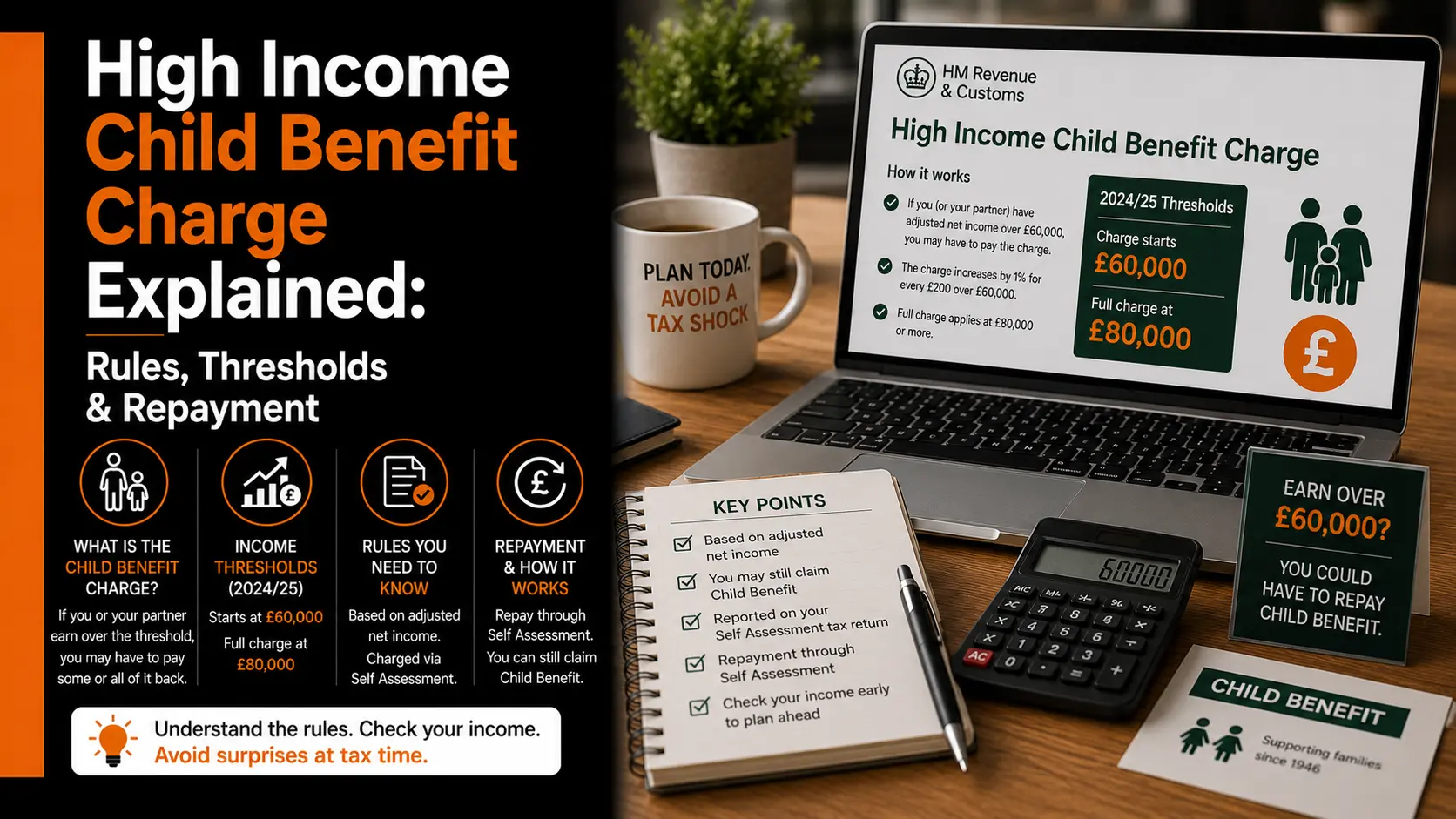
The high income child benefit charge threshold starts at £60,000 and grows from there, reaching full clawback at £80,000 for the current 2026-27 tax year, if income is between £60,000 and £80,000, the charge is calculated at 1% of the total Child Benefit received for every £200 of income above £60,000. Once income reaches £80,000 or more, the charge equals the full amount of Child Benefit received.
Individual Income vs Household Income
This is genuinely the biggest source of confusion, hands down. It’s based on the higher earner’s income alone, not your combined household total. Two parents each earning £59,000? They keep every penny. One parent earning £61,000, with a partner earning nothing at all? That household faces a charge.
What Is Adjusted Net Income?
Your total taxable income, minus things like pension contributions and Gift Aid donations. Not your salary alone, either bonuses, rental income, dividends, and savings interest all get added in first.

What Income Counts?
| Income Included | Income Not Included |
| Employment income | ISA interest |
| Bonuses and overtime | Child Benefit itself |
| Self-employment income | Certain disability benefits |
| Rental income | Gift Aid donations (deducted) |
| Dividends | Pension contributions (deducted) |
| Savings interest | |
| Pension income (in payment) |
How Is the High Income Child Benefit Charge Calculated?
Step-by-Step Calculation
- Work out your adjusted net income
- Subtract £60,000 from it
- Divide the result by £200
- That’s the percentage of Child Benefit you owe back, capped at 100%
Repayment Percentages Explained
| Income | Charge Percentage |
| £60,000 | 0% |
| £65,000 | 25% |
| £70,000 | 50% |
| £75,000 | 75% |
| £80,000+ | 100% |
Worked Examples
A parent on £61,000 pays roughly 5% back. Bump that to £65,000, and it’s 25%. At £70,000 with two children, the charge lands around £1,125 a year or roughly £94 a month through PAYE a parent earning £70,000 with two children would face a charge of around £1,125, equating to roughly £94 a month through the tax code. Cross £80,000, though, and the entire benefit gets clawed back.
Should You Still Claim Child Benefit?
Why Can Claiming Still Be Worthwhile?
Even if you’ll end up paying the full charge back, claiming still matters. It protects National Insurance credits toward your State Pension, and it gets your child a National Insurance number automatically at 16.Opting out does not affect entitlement and preserves National Insurance credits, which can help build entitlement to the State Pension, and ensures a child can receive a National Insurance number automatically at age 16.
These credits genuinely add up. Each qualifying year adds roughly £358 to your annual State Pension income. Miss five years, though, and you’re looking at £1,790 less per year in retirement around £35,800 over a 20-year retirement. Five missing years could reduce a State Pension by around £1,790 a year, which is roughly £35,800 across a 20-year retirement.
Claiming Without Receiving Payments
You can register for Child Benefit and opt out of actual payments. This protects the NI credits without any money changing hands, or any charge to calculate.
When Opting Out May Make Sense?
| Option | Best For |
| Claim and receive payments | Income under £80,000, want the cash flow |
| Claim but opt out of payments | Income near or over £80,000, want the NI credits without the paperwork |
| Don’t claim at all | Rare usually only if a partner already has full NI contribution history |
How to Pay the High Income Child Benefit Charge?
Paying Through Self Assessment
The traditional route. You declare the charge on your tax return and pay by 31 January following the tax year.
Paying Through PAYE
Since September 2025, employed taxpayers can pay through their tax code instead skipping Self Assessment entirely, if that’s the only reason they’d need to file that change in September 2025. HMRC launched a new online service, announced at the 2025 Spring Statement, to allow eligible taxpayers to pay HICBC without Self Assessment. It’s now fully operational. Just register by 31 January after the tax year ends.
Key Deadlines to Remember
| Method | Deadline |
| Self Assessment | 31 January following the tax year |
| PAYE registration | 31 January after the tax year ends |
How to Reduce the High Income Child Benefit Charge Legally?
Pension Contributions
Paying more into your pension lowers your adjusted net income directly. Push yourself back under £60,000, and the charge disappears entirely; this works because pension contributions come off your income before HMRC ever calculates the charge, not after.
Salary Sacrifice
Sacrificing salary for pension contributions, childcare vouchers, or other benefits reduces your taxable income the same way, before it ever counts toward the threshold. Plenty of employers offer this, and it’s often more tax-efficient than paying into a pension straight from your take-home pay.
Gift Aid Donations
Charitable donations through Gift Aid also reduce adjusted net income, genuinely lowering your charge while supporting a cause you care about. Keep records of every donation, since you’ll need these figures when calculating your final adjusted net income.
Other Legitimate Tax Planning Opportunities
Timing bonuses carefully, where your employer allows it, can help too. Deferring a bonus into a tax year where your income sits lower avoids pushing you unexpectedly into a higher charge bracket.
What Happens If You Don’t Report the Charge?
Late Registration and Penalties
Miss the deadline, and HMRC can charge a high income child benefit charge penalty plus interest on what’s owed whether you genuinely didn’t know about the charge or simply forgot.
Correcting Previous Tax Years
You can go back and correct earlier years if you missed the charge. HMRC generally allows corrections going back several years, though penalties may still apply, depending on the circumstances.

Common Mistakes to Avoid
Assuming household income determines the charge trips up more people than anything else.it’s the higher earner’s income alone that counts. Forgetting bonuses or dividends when working out adjusted net income is another common slip.
Missing Self Assessment or PAYE registration deadlines causes real problems too. So does skipping the claim entirely, purely to dodge the paperwork, and losing National Insurance credits as a result. And believing you shouldn’t claim Child Benefit at all above the threshold? Simply wrong claiming and opting out of payments protects your credits either way.
Common Myths vs Facts
| Myth | Fact |
| I can’t claim Child Benefit above the threshold | You can claim, and even opt out of payments while still protecting NI credits |
| Household income is used | Only the higher earner’s individual income counts |
| Bonuses don’t count | Bonuses count fully toward adjusted net income |
| Pension contributions make no difference | They directly reduce adjusted net income and the charge |
| Everyone must complete Self Assessment | PAYE registration now avoids this for many employed taxpayers |
Frequently Asked Questions
How much is the high income child benefit charge?
How much the high income child benefit charge question comes up constantly and the honest answer ranges from 0% at £60,000 income up to 100% at £80,000, worked out at 1% of your Child Benefit for every £200 of income above £60,000.
Is the high income child benefit charge unfair?
Plenty of families think so, particularly single-earner households who lose the benefit entirely while two-earner households on a similar combined income keep it. The government did consider moving to a household basis to fix this, but scrapped the plan back in 2024, purely on cost.
When did the high income child benefit charge start?
Back in January 2013, originally at a £50,000 threshold. Things changed significantly in April 2024, when the threshold rose to £60,000 and the taper softened.
How do I pay the high income child benefit charge?
Through Self Assessment, or through PAYE if you’re employed, using the online service HMRC launched in September 2025. Worth checking gov high income child benefit charge guidance directly for the latest registration links the PAYE route lets plenty of people skip a full tax return just for this charge.
Conclusion
Understanding your adjusted net income, and where it sits against the £60,000 to £80,000 range, changes how you approach Child Benefit entirely.
Review your income each year, especially if bonuses or dividends push you close to a threshold. Where things get complicated, professional advice tends to pay for itself. Seenews tracks HMRC changes like these as they happen, so you’re never caught out by a threshold that’s quietly moved.