You’ve decided to take your employer to tribunal. Now you’re staring at a form full of sections you don’t quite get. Your deadline isn’t obvious either. That’s where most people land when they first open the ET1 form.
The ET1 is where your claim starts. Get the deadline wrong, name the wrong employer, or skip a key fact, and everything after gets harder. Here’s what the form needs, how deadlines and Acas Early Conciliation work together, what goes in Section 8.2, and where people usually slip up.
What Is an ET1 Claim Form?
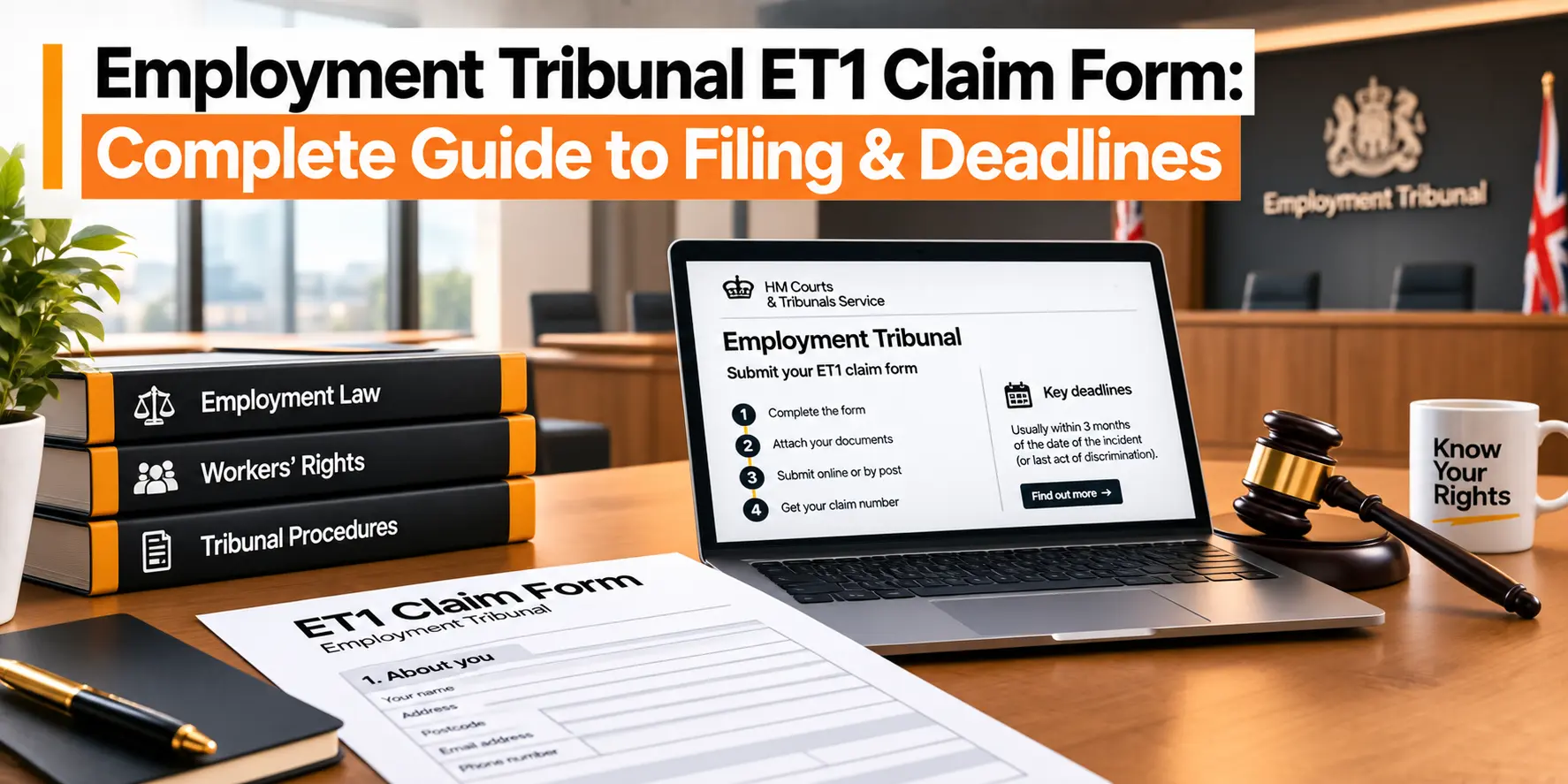
ET1 is the claim form that starts a case at an Employment Tribunal in England, Wales and Scotland. You need one when you’re bringing a formal claim against a current or former employer, and Acas conciliation hasn’t sorted things out.
Employees can bring a claim. So can some workers, depending on what the claim is. It comes down to your employment status and claim type. Common ET1 form claim types: unfair dismissal, discrimination, constructive dismissal, unpaid wages, holiday pay, redundancy disputes, working time breaches, breach of contract. Each has its own test, and some run on different deadlines.
How Long Do You Have to Submit an ET1?
Most claims need to go in within three months less one day of the event you’re complaining about. That’s the usual rule, not a fixed one. The clock usually starts from the act itself- your dismissal date, say, not the date an appeal got decided. Redundancy payments, especially, can run to different limits. Check the ET1 form time limit for your claim before you assume anything.
| Claim type | Usual time limit | Clock generally starts from |
| Unfair dismissal | 3 months less 1 day | Date of dismissal |
| Discrimination | 3 months less 1 day | Date of the discriminatory act (or last act, if ongoing) |
| Unpaid wages/holiday pay | 3 months less 1 day | Date of the unlawful deduction or non-payment |
| Redundancy payment claims | Can differ; often longer | Date entitlement arose |
| Breach of contract | 3 months less 1 day | Date employment ended |
Treat these as starting points, not rules carved in stone. Check your own deadline against current official guidance.
Close to the deadline? Start Acas Early Conciliation now; don’t wait around for more evidence. A tribunal can allow a late claim in rare cases, usually where filing on time genuinely wasn’t possible. ET1 form extension of time requests get looked at one by one. Nothing here is automatic.
Example: Employment ends 1 March. Before ACAS, your deadline usually lands around 31 May.

How Does Acas Early Conciliation Affect the Deadline?
Before you submit an ET1 claim form, ACAS conciliation is usually a required first step. It’s free, and Acas tries to help you and your employer settle things before the tribunal gets involved.
Here’s what it actually does to your clock: contacting Acas pauses it while conciliation runs, then stretches your deadline by however long that takes. It doesn’t hand you a brand new three months. Once conciliation ends, Acas sends an early conciliation certificate with a reference number. That number becomes your ET1 form reference number, and without it, most claims stall. Got more than one respondent? You’ll need a separate reference for each.
A grievance or appeal doesn’t stretch the deadline on its own. Nothing trips people up more than this one.
What Do You Need Before Completing the Form?
Gather these first:
- Claimant details: name, address, contact details
- Respondent details: employer’s correct legal name and address
- Employment dates and job information
- ACAS certificate information
- Employment documentation: contract, payslips, dismissal letter
- Key emails, messages and letters
- A timeline of events, in order
How to Complete the ET1 Step by Step?
Step 1: Claimant details. Name, address, contact details. Use ones you’ll actually check, since correspondence lands here.
Step 2: Respondent details. Use your employer’s correct legal company name, not the trading name on the shopfront, plus their registered address. More than one employer or a parent company involved? You might need multiple respondents. Got the name wrong? It can sometimes be fixed, but not always easily once the claim is moving. Best to get it right the first time.
Step 3: Employment details. Job title, start date, end date, employment status. Keep it matching your paperwork.
Step 4: ACAS information. Enter your certificate reference number. Most claims stall without it.
Step 5: Select your claim types. One dispute can throw up more than one legal claim unfair dismissal and discrimination, say- from the same set of facts. Not sure which applies? Ask, don’t guess. The wrong type can shape how your whole case gets read.
What Should You Write About Your Claim? (Section 8.2 )
What Is Section 8.2?
This is where you explain, in your own words, what happened and why you think you’ve got a claim. Arguably the most important part of the form.
What Should You Include?
What happened, the key dates, who was involved, the important decisions or actions, the relevant facts, why you think it was unlawful, and how it all ties to your claim.
Should You Explain Events Chronologically?
Usually, yes. A clear timeline is easier to follow than events scattered out of order.
How Much Detail Should You Include?
Enough to make your case clear. Not so much that it turns into a legal essay. A few well-organised paragraphs beat pages of narrative, almost every time.
What Should You Leave Out?
This isn’t a witness statement. Not an evidence bundle, a folder of emails, a long emotional account, or a case-law essay either. Save that for later.
Can You Add Additional Pages?
Yes, if you need to. Clarity still beats length.
Example: Vague: “My manager treated me unfairly for months.” Clear: “On 4 June, my manager removed me from the rota without explanation. When I raised this on 6 June, I was told my hours were being ‘reviewed.'”
What’s the Difference? (ET1 vs Particulars of Claim)
The claim form starts your case and covers the basics. Particulars of claim go further; often that’s Section 8.2 itself, or an extra document if you need the room. They help when a dispute is too complex for the standard space. Clear drafting simply makes it easier for everyone to follow your case from day one.
What Evidence Should You Prepare?
Not at the filing stage; generally, the ET1 explains your claim, and ET1 form evidence comes later. Worth keeping safe: your contract, payslips, emails and messages, letters, grievance documents, disciplinary records, dismissal paperwork, and any relevant workplace policies.
Witness statements turn up later, closer to the hearing. ET1 form expert evidence only matters in specific cases, often medical or technical ones most people won’t need.
How Do You Submit an ET1?
Most people file the ET1 form online through HM Courts & Tribunals Service post works too, though online’s quicker to track. Some systems let you save and come back, but check that won’t eat into your deadline. Hold onto your ET1 form submission confirmation, a copy of the form, and your Acas certificate, and don’t leave ET1 form filing to the last day. One glitch or missing detail can cost you time you don’t have.
What Happens After You Submit the Claim?
The tribunal sends your ET1 to the respondent. They usually get 28 days to reply with an ET3, and if they don’t, the tribunal might move ahead anyway. Sometimes a preliminary hearing comes first, to clear up issues early. After that, it’s typically case management, disclosure, exchanging witness statements, and hearing prep leading up to the ET1 form hearing date itself. Claims can be withdrawn or settled at any of these points, not just at a final hearing.
What Happens If You Make a Mistake?
Small errors can often be fixed if you flag them fast. Adding a new claim, new facts, or another respondent through ET1 form amendments is sometimes possible, but it’s never guaranteed. You’ll usually need tribunal permission, and adding a respondent gets harder still without a valid ACAS certificate for them.
Remedies and Compensation in an Employment Tribunal Claim
A tribunal can award compensation, reinstatement, or re-engagement, depending on the claim. A schedule of loss lists the money you’re claiming. It builds up as the case moves forward. Many claims include lost earnings where you can show a loss. Wages or holiday pay claims focus on getting back what’s owed, directly. Discrimination claims can add compensation for injury to feelings too. Figures often shift as more comes to light.
Common Mistakes to Avoid
- Missing the deadline is the most damaging one by far
- Assuming a grievance extends the deadline; it usually doesn’t
- Using the wrong respondent: check the legal company name
- Forgetting Acas information: claims get rejected without it
- Selecting the wrong claim type: get advice if unsure
- Leaving out an important claim or fact; amending later isn’t guaranteed
- Writing too little or too much in Section 8.2
- Treating the claim form like a witness statement
- Attaching evidence instead of explaining the claim
- Not keeping your submission confirmation
- Waiting until the final day
ET1 Deadline Examples
Illustrative only, not personalised advice.
- Unfair dismissal: Dismissed 10 January. Deadline before Acas, usually around 9 April.
- Acas conciliation: Contact made before the deadline stretches it by however long Acas took.
- Discrimination: An act on 15 May starts a similar clock, though ongoing discrimination can shift the date.
- Multiple claims: Unfair dismissal and wages claims from one dismissal often share a similar timeframe. Check each anyway.
- Approaching the deadline: Two weeks left, no Acas certificate yet? Get in touch with Acas today.
ET1 Submission Checklist
Before starting: check the deadline, sort your Acas requirements, confirm the respondent, gather documentation, build a chronology.
Before submitting: check claimant and respondent details, employment dates, Acas information, claim types, Section 8.2, compensation details, the deadline again, and save a copy.
After submitting: save your confirmation, keep a copy of the claim, watch for tribunal correspondence, organise your evidence, and watch for the ET3.
Conclusion
Filing an ET1 comes down to a few essentials. Check your deadline first. Understand how Acas Early Conciliation affects your timing, and name the right respondent. Explain your claims carefully, set out the key facts clearly in Section 8.2, and keep proof of everything you submit.
Circumstances differ, and tribunal rules can be trickier than any one article can capture. If your deadline is close, or your case is unusual, check the latest official GOV.UK and Acas guidance, or get proper advice before you file. Seenews will keep covering guides like this one to help you stay on top of UK employment rules and procedures.