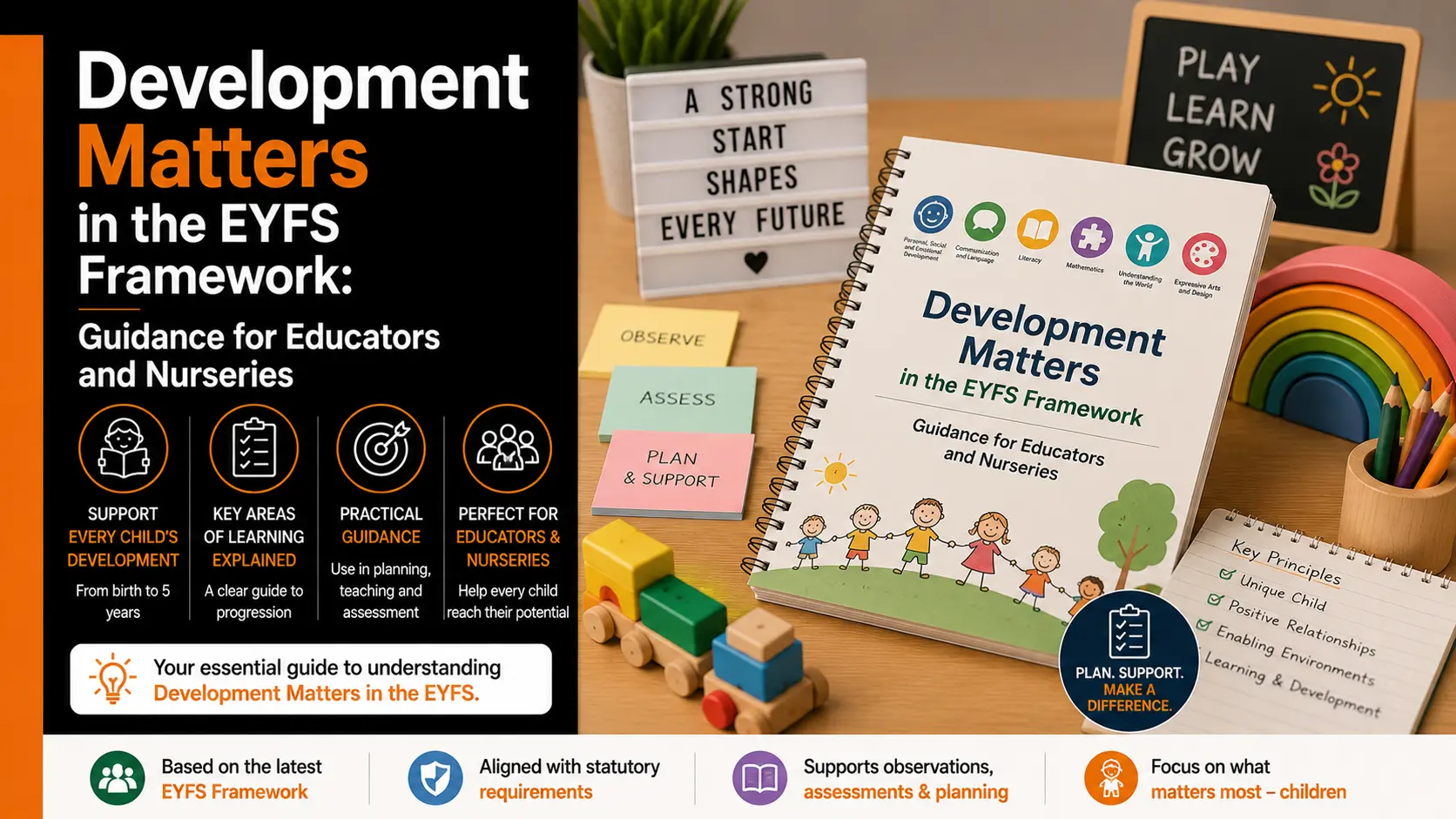
A nursery manager once told me she’d spent a whole weekend colour-coding tracking sheets for every child in her baby room. Come Monday, an inspector asked her one question: “What does this child enjoy doing, and why?” She couldn’t answer it from the spreadsheet. That’s the whole problem right there. Treating development matters in the EYFS like paperwork instead of something you actually understand.
Development Matters is non-statutory guidance. Sits next to the EYFS statutory framework, but it isn’t the law itself. People mix the two up constantly, and it causes real damage: burnt-out staff, worried parents, curriculum decisions built on nothing solid.
So here’s what the guidance actually says, how it fits with the statutory side, and how to use it without burying your team in paperwork.

What Is Development Matters in the EYFS?
It’s a guidance document. Helps early years staff understand how children usually develop, and how to shape a curriculum around that.
Think map, not instruction manual. Shows you the general shape of child development. Won’t tell you exactly which path any one child takes, because kids don’t work that way.
Nurseries use it for curriculum design across the seven areas, day-to-day observation, and conversations with parents about progress. None of that is box-ticking. It’s understanding a kid.
Is It Statutory?
No. The EYFS statutory framework is the legal bit. Development Matters just supports it.
The framework covers what settings must do safeguarding, staff ratios, the areas of learning, assessment points like the two-year check and Reception Baseline. Development Matters gives you a non-statutory way to understand how kids move through those areas. Confuse the two and you’re enforcing rules that literally don’t exist.
How Development Matters Fits Into the EYFS Framework?
Statutory framework: the destination. Development Matters: one route there, not the only one. Settings meet legal requirements no matter which guidance they lean on. Development Matters was never built to replace that framework, treat it like a rulebook and you’ve missed the point entirely.
Can Nurseries Build Their Own Curriculum?
Yes. Most do. Any setting can design its own curriculum, provided it hits the statutory requirements underneath.
Development Matters can shape that thinking. It shouldn’t dictate it. A childminder with three toddlers plans nothing like a sixty-place nursery does. Professional judgement leads here, not a document.
The Seven Areas of Learning
Three prime areas underpin everything:
- Communication and Language listening, understanding, expressing yourself
- Personal, Social and Emotional Development confidence, relationships, self-regulation
- Physical Development movement, coordination, independence
Four specific areas build on those:
- Literacy early reading and writing
- Mathematics number, pattern, spatial reasoning
- Understanding the World people, places, the natural world
- Expressive Arts and Design art, music, imaginative play
They overlap constantly in real practice. A kid building a den outside is doing physical development, language, and problem-solving, all at once, without knowing it.
Development Matters Age Bands Explained
Birth to 3 covers rapid, messy development. One eighteen-month-old walks confidently; another’s still cruising along the furniture. Both are fine. This guidance should inform observation. Not set a deadline.
Three- and four-year-olds learn mostly through play. Sorting conkers by size? That’s maths. Taking turns on a bike? Social skills. Use the guidance to notice what’s emerging, then build on it.
In Reception, it still matters feeds into the Early Learning Goals kids work toward by year’s end. A bridge. Not a separate system.
Are Age Bands Strict Targets?
No. And this is where most of the anxiety comes from. Kids develop at wildly different rates. Age bands describe typical ranges, not checkpoints you fail if missed. A child behind in one area might be way ahead in another. Depth beats ticking a date off a chart, every time.
Using Development Matters in Practice
Planning
No fixed checklist here. The guidance backs planning around kids’ actual interests and stage, not some rigid template you’re forced to follow.
Good planning starts with what kids are already doing. Half the room obsessed with dinosaurs? That’s your way into language, counting, and creative work. Not every activity needs a formal link to a statement that habit just eats time and improves nothing.
Continuous Provision and Child-Led Learning
A well-set-up environment teaches on its own. Mud kitchens, construction areas, book corners kids explore without an adult hovering over every second of it. Practitioners extend learning through conversation, not constant intervention. One good question at the water tray teaches more than a planned session ever will.
Following a child’s lead doesn’t mean disappearing entirely though. Watch closely. Step in at the right moment to stretch thinking, drop in new vocabulary. Knowing when to join in versus when to let a kid figure it out alone that’s the actual skill.
Identifying Next Steps
Three questions. What does the child already know or do? What’s just starting to show up? What experience builds on that naturally?
Keep the answer practical. “Offer scissors during craft time” beats a paragraph written for a folder nobody opens again.
Assessment and Observations
Assessment comes from professional judgement, from actually watching kids in real moments not a form filled in from memory at 5pm. The guidance helps you interpret what you see. It was never built to generate a score.
A useful observation is specific enough to act on. “Ahmed enjoyed painting” tells you nothing. “Ahmed mixed blue and yellow independently and named the colour he made” now you know exactly where his understanding sits. It takes a few seconds longer to write. Worth ten times as much.
Not every moment needs writing down. Try to log everything and you’ll actually notice less, not more. Mix it up: a handful of detailed written observations, photos with a short caption, the odd video for physical skills, ongoing chats with the child’s key person.
Enough evidence means enough to understand the child. Not enough to fill a folder. Documentation should serve the kid, not the inspection. More paperwork rarely means better assessment, usually it just means less time actually with the children.
Do You Have to Tick Off Every Statement?
No. This misunderstanding wastes more hours than almost anything else in early years work. Checklist culture ticking off statements one by one misses the entire point. A ticked box tells you nothing about whether a child actually understands something, or can use it somewhere else.
Try this instead: Observe → Understand → Respond → Review. Watch what a kid does. Work out what it tells you. Adjust your interactions or provision. Check back later, see what’s shifted. That builds understanding. Box-ticking just builds paperwork.
Development Matters vs Birth to 5 Matters
Birth to 5 Matters covers similar ground. Separate document, non-statutory too. A coalition of early years organisations put it together, not the government.
| Development Matters | Birth to 5 Matters | |
| Purpose | Support EYFS curriculum planning | Support EYFS curriculum planning |
| Status | Non-statutory | Non-statutory |
| Developmental guidance | Age-banded ranges | Broader developmental ranges |
| Curriculum planning | Structured around seven areas | Structured around seven areas |
| Assessment support | Informs judgement | Informs judgement |
Pick either one. Blend both if that works better. Just meet the statutory framework and don’t build two separate tracking systems that do the same job twice.
Development Matters vs Early Learning Goals
The Early Learning Goals are the statutory expectations kids get assessed against at the end of Reception. A snapshot, one moment in time.
Development Matters describes a journey. The goals mark where that journey ends. Build a two-year-old’s curriculum around Reception-level goals and you’re ignoring everything we know about how young kids actually learn. Those goals belong at the end of the road. Not the start.
Common Pitfalls and Risks
Same mistakes, over and over, across settings:
- Treating the guidance as a checklist
- Forcing every activity to link back to a statement
- Piling up documentation nobody reads again
- Chasing evidence instead of watching kids learn
- Treating age bands like deadlines instead of typical ranges
- Confusing non-statutory guidance with law
- Using Early Learning Goals as an everyday curriculum
- Building tracking systems that duplicate each other
Every single one traces back to the same root cause. Treating guidance like a rulebook instead of a tool.
Implementing It Without Piling on Workload
A handful of habits actually matter here:
- Keep planning purposeful real interests, not a template
- Focus on the moments that genuinely shift a child’s understanding
- Trust professional judgement over rigid formulas
- Let continuous provision do more of the heavy lifting
- Cut tracking and documentation back to whatever actually informs practice
Workload rarely comes from the guidance itself. It comes from settings piling layer after layer of process on top of something the guidance never asked for.
Development Matters for Different Needs
Works best when it sits alongside a setting’s own curriculum, not instead of it flexing around the kids in the room, not the other way round.
Age bands get a lot less useful for children with SEND. That’s fine. Build support around the individual child, adapt provision and resources, don’t force progress through some fixed sequence. Same story for any child developing unevenly sprints ahead in language, lags in physical skills, or the reverse. Observation and judgement beat any age band, every time.
Development Matters EYFS Training
Good training covers how the guidance actually works, and just as importantly, what it doesn’t require. Curriculum planning grounded in real practice. Observation and assessment that doesn’t drown you in paperwork. Practical implementation across different room types. Genuine confidence in your own professional judgement.
Look for UK providers with real context, current guidance, actual examples from real settings not generic theory lifted from somewhere else. Costs vary a lot by provider, length, delivery method. In-house training for a whole staff costs differently than one person doing an online course. Just check with providers directly for current pricing.
How Parents Can Understand Development Matters?
A checklist wouldn’t tell parents much anyway. Development is uneven ticked boxes hide more than they reveal. Outside an age band doesn’t mean falling behind. Age bands describe common patterns. Not fixed rules.
Everyday stuff teaches more than flashcards ever will cooking together, reading the same book for the hundredth time, letting a kid help with something real. Worth thinking about the costs alongside the development too. Working parents can offset nursery fees through Tax-Free Childcare, check their savings with our Tax-Free Childcare Calculator, and see the latest Child Benefit rates.
Also Read: Tax Free Childcare: How It Works, Eligibility & How to Apply in the UK
Conclusion
Development Matters exists to help you understand kids. Not to generate paperwork. It sits beneath the EYFS statutory framework as guidance, not obligation, a lens, not a ledger.
Kids develop at their own pace. No amount of tracking changes that. Use the guidance to understand a child better, not to prove every statement got covered somewhere. That shift alone kills most of the workload anxiety this stuff tends to create.
SeeNews tracks EYFS and early years policy changes and turns them into plain, practical updates so practitioners can stay informed without becoming policy experts, and keep the focus where it actually belongs. On the kid in front of them.