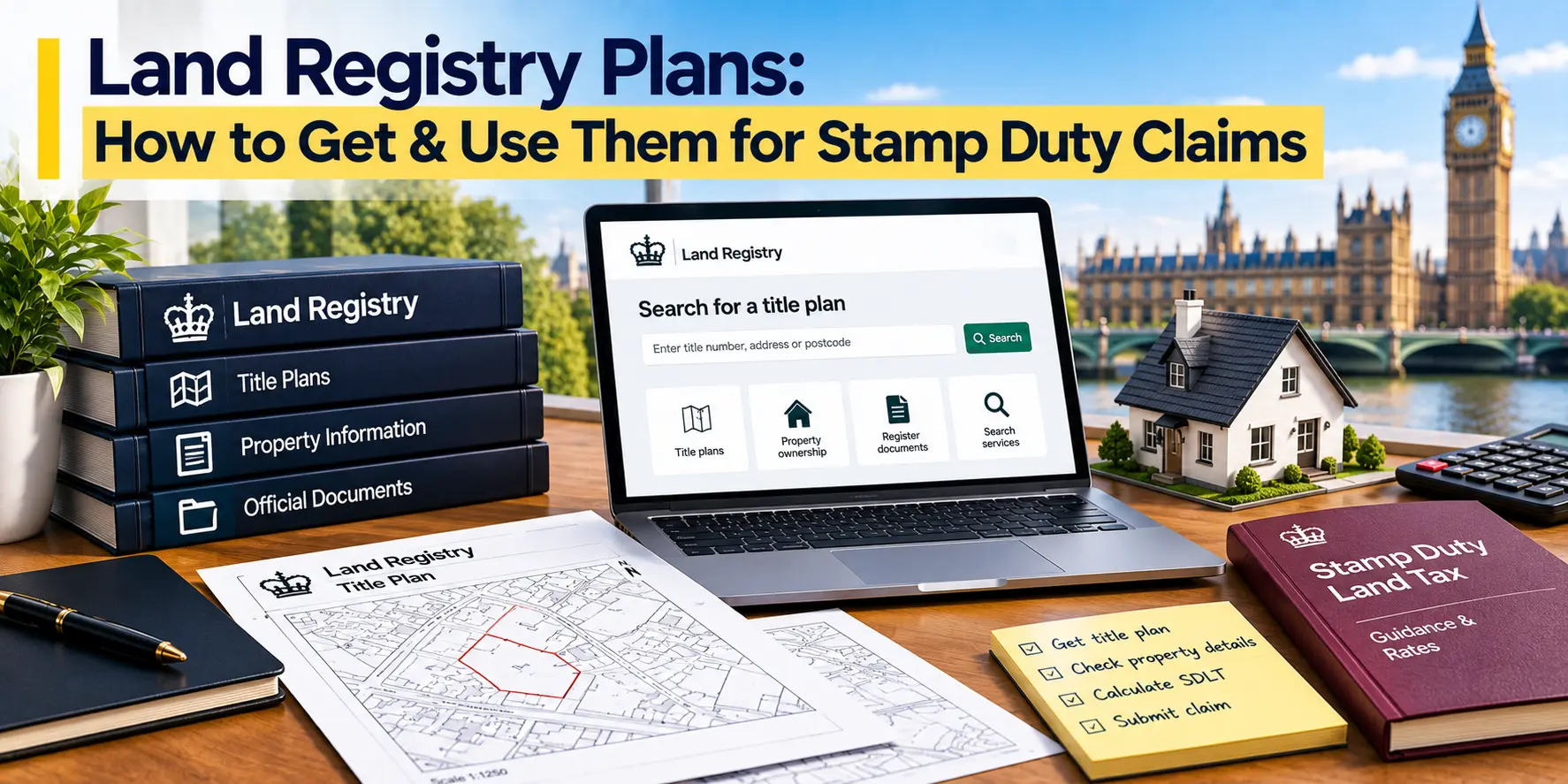
Many people don’t look at their Land Registry plan until something is wrong. Either the garden seems too large to be the size shown on the map, or there is apparently some other second title number. Land registry plans UK buyers can now obtain online are a good starting point for investigating issues with Stamp Duty, but remember that these are pieces of evidence. The plan confirms registered land, but it cannot necessarily tell you whether you have paid too much.
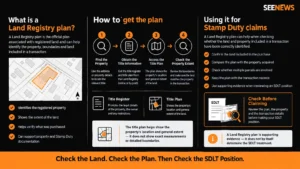
What is a Land Registry Plan?
A register of land plot maps held by HM Land Registry.
What does a Land Registry plan show?
A Land Registry title plan shows where your property is and where the approximate boundaries are. The title number is shown on the land registry plan as well as the register.
What are the red lines on a Land Registry plan?
They mark the approximate extent of the land covered by the title, but do not take these as definitive. Under section 60 of the Land Registration Act 2002 it is a general boundary and so your fence may well not follow this line.
The Land Registry Plan vs Title Register
The plan is like a picture and the register is like the small print, with the register giving additional information such as who owns the land, the title number and the price paid. Always read the title register and title plan together.
The Land Registry Plan vs Other Property Documents
This comparison shows what each document is for.
| Document | What it shows | What it doesn’t show |
| Title plan | Registered land and general boundaries | Exact fence lines or tax treatment |
| Title register | Owner, title number, price paid, rights | The layout of the land |
| Deeds and deed plan | Historic transfers and land descriptions | Whether current registration is complete |
| Planning site or block plan | Proposed development on a site | Registered ownership |
| Boundary survey | Measured features on the ground | Legal ownership |
| SDLT5 | HMRC’s certificate that a return was filed | Whether the right rate was applied |
How to get a Land Registry Plan?
How to find a property’s title plan?
You can search for the property by address, postcode or on a map on GOV.UK and obtain land registry plans. It only takes a few minutes to obtain land registry plans online. Compare the title number shown on the plan with that on your transfer and check if the garage or plot of land adjoining your property is shown as being under a different title.
How much does a Land Registry Plan cost?
£7 online and £7 for the register, while official copies sent by post cost £11 each. Always check the land registry plans cost before ordering.
Do I need to be the registered proprietor to get a Land Registry plan?
No, anyone can search for information on registered land in England and Wales, whether they are the owner or not.
What if I can’t find the property?
There are several reasons why you may not be able to find a property, including:
- Your property is split into a number of titles;
- The address has changed due to numbering changes or a conversion;
- The land is not registered;
- You chose the wrong title from the search results.
The GOV.UK website has more information about being unable to find a property and also offers an index map search for unregistered properties.
Online or official copy?
You can usually rely on an online copy for anything other than proving ownership of the property, since only the official copy is legally binding. Neither an online or official copy can guarantee a claim, so check with HMRC or your adviser about what you need before spending money on land registry property information that you do not need.
How to read a Land Registry Plan?
Interpreting the red edging
First of all, always be aware that the red edging indicates approximate boundaries. Other colours or markings may be present and these should be interpreted according to the register.
Interpreting the scale
A title plan is not a survey. On a typical plan the width of a house is shown as a thin line. Ask a surveyor about measurements.
Identifying the house, garden, land etc
Look for the house depicted on the plan first and then work outwards to the garden, garage, outbuildings and adjoining or separate plots which may be marked on the plan. Each of these may have a title of their own. If you need to identify a planning site or a block plan this is a separate document to the title register.
What if my Land Registry Plan does not match?
Surveying and mapping can only be approximate and so boundaries shown on the plan may not reflect the actual ground conditions. Compare it to your deeds and any land registry deed plan you have to check what has been registered.
A discrepancy in the plan does not always indicate a land registry boundary dispute. If the mismatch appears to be significant consult HM Land Registry and/or a surveyor about your land registry property boundaries. If you identify an obvious error, request a land registry plan update.
How a Land Registry Plan Can Help With a Stamp Duty Claim?
When can a title plan be useful for a claim?
It can help identify what land is registered and sold so that you know what you are claiming about. Land registry plans for stamp duty reviews can be used to show the extent of the property, identify separate titles and help highlight any additional land that may need to be considered.
Can a Land Registry Plan prove that I overpaid stamp duty?
Not on its own, since the claim depends on the transaction, not the survey. SDLT is due on the purchase price, the type of property bought and any applicable reliefs. The plan identifies the land, but how it is classified for tax purposes is a separate matter.
Can a Land Registry Plan show that the property was charged the wrong rate?
A land registry plan indicates how the land parcel is divided, but it does not specify the type of each division. You will need to consider this alongside other factors such as the use of the property. The GOV.UK website lists paying residential rates where non-residential rates applied as a potential reason for a refund, but you will need to determine whether this applies to your situation.
Can a Land Registry Plan show that large gardens or additional land reduce stamp duty?
If the land is considered to be part of the land or garden surrounding a home it will be classed as residential regardless of its size, but separate land may be classed differently. The HMRC website has more information about the classification of land for Stamp Duty purposes. Any land registry plans HMRC has seen will identify how the land is registered, not how it is used.
What other documents may I need for an SDLT claim?
The Land Registry documents are only one part of a claim since HMRC considers the wider transaction and not just the land registry records. The following documents can help support a claim:
Title register
This confirms who owns the land, what was paid and what rights are attached to it.
SDLT5
This is the certificate from HMRC that a Stamp Duty return has been submitted.
TR1 Transfer Form
This identifies the parties to the transaction, what was paid and what land was transferred.
Purchase Contract
This sets out the consideration paid for the property.
Completion Statement
This itemizes the amounts paid including the Stamp Duty payment.
Additional evidence
Deeds, land registry historic plans, land registry amended plans and planning documents such as those showing use and valuation can also be used in conjunction with land registry property information to support a claim.
Common situations where a Land Registry Plan can be important
You bought a house with additional land
If there is a paddock adjoining your garden this may have a separate title so that it is important to check the land registry plans against your TR1 to confirm what you purchased.
Your property has more than one title
Garages and small plots of land often have separate titles so make sure to download all of the relevant land registry plans and cross-check them against your purchase documents.
Your property includes commercial space
A shop attached to a flat can affect the rate of Stamp Duty due and the division of the land between residential and commercial use has to be taken into account when considering whether a refund is due.
How to use your Land Registry Plan when investigating an SDLT overpayment?
Step 1
Find your property and transaction details
Note the address of the property, the date of completion and the SDLT return reference.
Step 2
Get the relevant land registry plan
Download the plan from the GOV.UK website.
Step 3
Get the title register
This will confirm the title number, the owner of the land and the purchase price.
Step 4
Check for additional titles
Look out for additional land such as a garage or plot adjoining the property.
Step 5
Cross-check with your purchase documents
Make sure that the details on the land registry plan match those in your TR1, purchase contract and completion statement.
Step 6
Work out why you think you have overpaid SDLT
Review the reasons why you think you have been charged incorrectly.
Step 7
Check the deadlines for making a claim
There are different deadlines depending on the circumstances so double-check the information before you make a claim.
Step 8
Gather any additional evidence that may help your case
Use the documents listed earlier to support your claim.
Step 9
Submit the relevant claim to HMRC
Always check with HMRC about the correct way to make a claim. Not all inaccuracies can be refunded.
How long do I have to claim a stamp duty refund?
It depends on the reason for your claim since there are a number of options open to you.
General Stamp Duty overpayments
You can usually amend aSDLT return within one year of its filing date. Overpayment relief claims usually have a four year time limit from the effective date of the return, but there are restrictions.
Higher-rate Stamp Duty refunds
If you sold your former main residence within three years of buying the new home you may be able to claim a refund of the higher-rate SDLT. Check the GOV.UK refund page for the latest information on higher-rate SDLT refunds.
Why is the correct claim route important?
You must choose the right option when making a claim since you could lose out on a refund if you make a mistake. Always check the eligibility criteria for each option before you submit your claim.
Common misconceptions about land registry plans and stamp duty
The red line shows my exact boundary
The red line only shows a general boundary so your fence may be in a different position.
A land registry plan means I am entitled to a refund
A plan only confirms the extent of the registered land, but not whether you have been charged incorrectly.
A Large Garden Means I Paid Too Much Stamp Duty
Just because a property has a large garden does not automatically reduce the SDLT charge. The use of the land and additional factors must be taken into account when determining the rate.
Separate land means a property is non-residential
A separate title is just one factor that must be taken into account when determining whether a property is residential or not.
Common mistakes to avoid with land registry plans
Land registry plans rarely cause problems on their own. The most common mistakes happen when a number of steps are missed, such as:
- Looking at just one title when there are several connected to the property.
- Failing to compare the plan with the register.
- Assuming that the red line defines precise boundaries.
- Paying for an official copy when an online version is sufficient.
- Thinking that the plan proves a case.
What to check before using an SDLT refund company?
There are a number of questions you should ask before you use an SDLT refund company, including:
- Why do they think you have overpaid?
- What evidence do they need from you?
- Is the fee a percentage or a fixed charge?
- What happens if the claim is refused?
You should always be aware that whoever makes the claim on your behalf is responsible for its accuracy.
Land Registry Plan and SDLT Checklist
- Address
- Title number
- Title plan
- Title register
- SDLT5
- TR1
- Contract Completion statement
- Additional title plans
- Deeds or historic plans
- Use evidence
- Original SDLT calculation
- Reason for suspected overpayment
- Claim deadline
Conclusion
And so we come to the end of this guide to Land Registry Plans. Remember to get the plan and work out what it shows, check the register and compare it to your own documents, then work out your options for a SDLT refund. By following these steps Land Registry owners in the UK can download these valuable pieces of evidence and make the best possible claim.
Seenews can help with the next steps by providing practical guides and finance news. If you are affected by an SDLT overpayment and need to claim a refund consider using our NHS take-home pay calculator or tax-free childcare calculator.