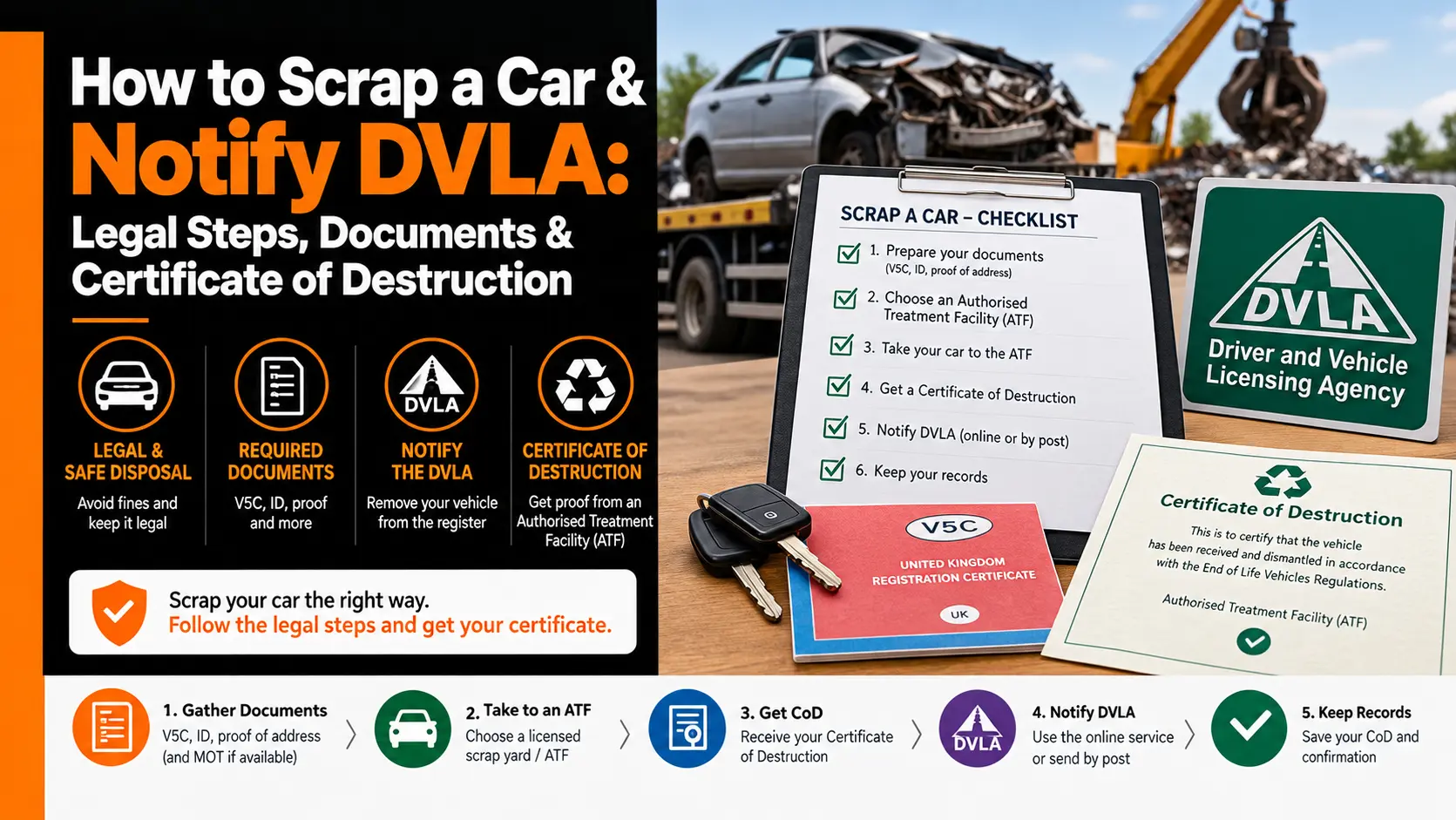
Your car’s finally given up. Maybe the cambelt went, maybe the MOT bill came back higher than the car’s worth, or it’s just been sitting on the drive going nowhere. Whatever brought you here, scrapping a car DVLA notification is the part most people get wrong not because it’s complicated, but because nobody explains it before the tow truck shows up.
Handing over the keys is the easy bit. What protects you afterwards is the paperwork: a Certificate of Destruction, telling DVLA the car’s gone, and keeping proof. Skip that, and you could still be the registered keeper of a car that no longer exists meaning tax reminders, insurance queries, and occasionally a fine, months later. This guide covers finding a legitimate scrapyard, the documents you need, how DVLA notification works, and what to do if something’s already gone wrong.
How to Scrap a Car in the UK?
1. Find an Authorised Treatment Facility
Not every yard that buys old cars is legally allowed to scrap them. Only an authorised treatment facility car operators licensed for an ATF can legally depollute, dismantle and destroy a vehicle, and only an ATF can issue a Certificate of Destruction.
An ATF holds an environmental permit and is inspected on how it handles hazardous parts. Scrapping a car licensed dealer or scrapping a car dismantler may be part of a legitimate chain some collect on behalf of an ATF but the car still needs to reach a genuinely authorised site. Check the Environment Agency’s (or SEPA’s) public register if unsure.
2. Prepare the Required Documents
Before collection, get your paperwork together. This is where scrapping car documents needed questions usually start: your V5C (scrapping a car log book), its 11-digit reference number, photo ID if asked, and spare keys if you have them.
If you’re scrapping a car V5C has gone missing, don’t panic just note the registration and, if possible, the reference number before the car leaves your hands.
3. Arrange Collection or Deliver the Vehicle
Non-runners need collection. Even if the car starts, think before driving it anywhere: an untaxed, uninsured or MOT-less car can’t legally go on public roads, regardless of destination. An ATF can transport such a vehicle on a trailer; you can’t drive it there. Confirm the agreed price, payment method, and driver details before they arrive.
4. Hand Over the Vehicle
The ATF should give you a receipt confirming registration, date and mileage and keep it as evidence the car left your possession. You’ll hand over the V5C here too, so copy the reference number down first.
5. Receive Your Certificate of Destruction
The certificate of destruction car owners receive is legal proof the vehicle’s been formally destroyed and deregistered. Under the End-of-Life Vehicles Regulations 2003, an ATF must issue one once it accepts the vehicle for treatment.it’s a legal obligation, not a courtesy.
6. Notify DVLA and Complete the Process
The final scrapping of a car process steps close the loop with DVLA. Make your own scrapping a car final check by confirming they no longer list you as keeper until that happens, the car is still legally yours on paper.
How to Notify DVLA When Scrapping Your Car?
Yes you, the registered keeper, are responsible for scrapping a car DVLA notification, even if a scrapyard’s handling the physical car. This is the step people wrongly assume someone else is doing.
The quickest route is GOV.UK‘s free online service, available 7am to 7pm there’s no fee for DVLA car scrap notification. You’ll need the registration number, the 11-digit reference number from the V5C, the ATF’s name and address, and the date it was scrapped.
By post, complete the yellow section of the V5C and send it to DVLA, Swansea. On log books issued before April 2019, that’s Section 9; from April 2019 onwards, Section 4 both cover transferring a vehicle to the motor trade, and scrapping counts as that, even with no money changing hands. There isn’t a separate standalone scrapping a car DVLA form.it’s this V5C section, or its online equivalent.
DVLA sends confirmation by email, followed by a letter confirming you’re no longer keeper. Keep it, and chase them if nothing arrives within four weeks.
Does the Scrapyard Notify DVLA or Do You Have To?
You have to. A scrapyard collecting your car doesn’t automatically notify DVLA, and assuming otherwise is where people come unstuck. An ATF’s legal duty is to issue a Certificate of Destruction; DVLA notification is often handled as a courtesy, but it’s optional on their part.
Don’t treat a verbal “we’ll sort DVLA” as the end of it. Check your DVLA record online a couple of weeks after collection, and if it still shows you as keeper, notify DVLA yourself.it costs nothing and takes minutes.
What Documents Do You Need to Scrap a Car?
Beyond the V5C, an ATF typically wants ID (especially if you’re not there in person) and spare keys.
Can You Scrap a Car Without a V5C?
Yes, in most cases. If it’s lost, never arrived, or is damaged, tell the ATF legitimate operators deal with this often. Notify DVLA by post instead, with a letter giving your name and address, the vehicle’s registration, make and model, and the ATF’s details.
What Is a Certificate of Destruction?
A Certificate of Destruction is the ATF’s confirmation, issued to the last owner, that the vehicle’s been accepted for treatment and formally destroyed. Only a licensed ATF can issue one, and it’s what DVLA relies on to confirm the vehicle genuinely no longer exists. Keep it for several years as proof if you’re ever chased over tax, and follow up in writing if one doesn’t arrive within a couple of weeks.
Certificate of Destruction vs DVLA Notification
These get conflated constantly, but they’re not the same, and mixing them up is exactly how people end up still on DVLA’s books months after the car’s gone.
| Certificate of Destruction | DVLA Notification | |
| Issued by | The ATF | You, the registered keeper |
| What it proves | The physical vehicle has been destroyed | DVLA’s records now show you’re no longer keeper |
| Legal basis | End-of-Life Vehicles Regulations 2003 | Vehicle registration rules |
| Cost | Free a legal obligation on the ATF | Free |
| What happens if it’s missing | No proof the car was legitimately destroyed | You remain liable for tax and any penalties |
You can have one without the other a CoD sitting in a drawer while DVLA’s system still lists you as keeper because nobody completed the notification. Treat them as two separate jobs, not one.
What Happens to Your Car Tax and Insurance?
Once DVLA processes your scrapping a car tax notification, full months of tax remaining are refunded automatically Direct Debit cancels itself, or DVLA sends a scrapping a car refund cheque, calculated from the date they receive your notification, not the date the car was scrapped. Delay telling them and you lose refund months.
DVLA notification doesn’t touch your insurance, that’s a separate call to your insurer. Most scrapping car insurance refunds are calculated on remaining full months, minus any cancellation fee. If the car was written off through a claim rather than sold directly, don’t assume scrapping resolves that claim; it’s handled separately.
Can You Scrap a Car Without an MOT, Tax or Insurance?
Yes to all four scrapping a car MOT status, tax, insurance and SORN standing make no difference to whether an ATF can accept the vehicle. They only matter for driving it there yourself: an untaxed, uninsured or MOT-less car can’t legally go on the road, so arrange collection instead. If you’re weighing up whether it’s worth an MOT first, our MOT costs guide breaks down current pricing, and if the car’s simply sat there untaxed, see our guide on reporting or resolving an untaxed vehicle. Non-running vehicles are routine too, just tell the collection company in advance.
Can You Scrap a Car With Outstanding Finance?
If there’s scrapping a car finance outstanding, the car isn’t fully yours to dispose of. Under a typical scrapping of a car hire purchase agreement or PCP, the finance company owns the vehicle until the final payment clears, so contact them first they’ll want the balance settled from any scrap value, or a settlement figure paid before release. Get this confirmed in writing.
What Happens to a Private Number Plate?
If you want to keep a private registration, removing it from DVLA’s records before scrapping transferring it to a retention certificate takes minutes online. Sort this afterwards and it’s far more difficult.
How to Avoid Scrap Car Scams and Problems?
Check the ATF is genuinely licensed, get more than one quote, and agree on the payment method before collection. Watch for a quoted price dropping once the driver arrives, a known tactic and ask upfront about collection charges for non-runners.
What If You Have Already Scrapped Your Car?
If the car’s collected but DVLA hasn’t been notified, do it yourself now, online or by post. If the scrapyard took your V5C, get the ATF’s name, address and collection date, then notify DVLA by post. No Certificate of Destruction turned up? Request it in writing, and if there’s no response, report the operator to the Environment Agency or SEPA.
Still shown as keeper, still charged tax, or received a penalty after scrapping? Resubmit notification and respond with your CoD, collection note and dates as evidence, then follow up by phone if nothing changes within a few weeks.
What Happens to a Car After It Is Scrapped?
The ATF depollutes its first draining fuel, oil and coolant, removing the battery all handled as hazardous waste under scrapping a car environmental regulations. Reusable parts are stripped for resale, then what’s left is crushed and shredded, with materials sorted for recycling under end of life vehicle and ELV recycling regulations governing scrapping a car disposal and scrapping a car waste disposal. On scrapping car recycling rates, figures vary by year and source, so rather than quote a stale number: the large majority of a vehicle’s material by weight gets recovered, metals especially.
Scrap Your Car or Sell It: Which Is Better?
It depends on the condition. A car with a valid MOT, working mechanically and reasonably tidy, is usually worth more sold privately or part-exchanged scrapping a car salvage value rarely competes with a working vehicle’s market price. Scrapping makes more sense when repairs would cost more than the car’s worth, it’s a non-runner beyond parts value, or you just want it gone without haggling. Get a couple of valuations first.
Common Mistakes to Avoid When Scrapping a Car
The recurring ones: assuming the scrapyard has notified DVLA without checking, losing the Certificate of Destruction, cancelling insurance too early, and forgetting a private plate is still attached are all avoidable with a few minutes of checking beforehand.
Conclusion
The physical act of scrapping a car is the easy part. What protects you is the sequence around it: use an authorised facility, prepare your documents, hand over the vehicle, get your Certificate of Destruction, notify DVLA yourself, check your tax refund, and keep every piece of paperwork.
Scrapping a car DVLA notification isn’t something to leave to assumption. Complete it properly, and a car long gone from your driveway won’t come back to cause problems months down the line. For more practical guides like this one on DVLA rules, vehicle tax and the everyday decisions that come with owning a car, SeeNews has you covered.